


 Cart
Cart
 sales@molnova.com


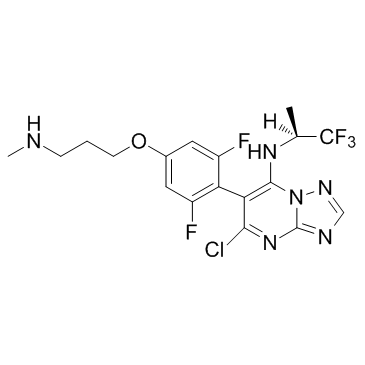
Cevipabulin
CAS No. 849550-05-6
Cevipabulin( —— )
Catalog No. M32838 CAS No. 849550-05-6
Cevipabulin (TTI-237) is a microtubule-active antitumor compound and inhibits the binding of [3H] vinblastine to tubulin (IC50: 18-40 nM in the human tumor cell line).
Purity : >98% (HPLC)
 COA
Datasheet
HNMR
HPLC
MSDS
Handing Instructions
COA
Datasheet
HNMR
HPLC
MSDS
Handing Instructions
| Size | Price / USD | Stock | Quantity |
| 1 mL x 10 mM in DMSO | 61 | In Stock |


|
| 5MG | 51 | In Stock |
|
| 100MG | Get Quote | In Stock |
|
| 200MG | Get Quote | In Stock |
|
| 500MG | Get Quote | In Stock |
|
| 1G | Get Quote | In Stock |
|
Biological Information
-
Product NameCevipabulin
-
NoteResearch use only, not for human use.
-
Brief DescriptionCevipabulin (TTI-237) is a microtubule-active antitumor compound and inhibits the binding of [3H] vinblastine to tubulin (IC50: 18-40 nM in the human tumor cell line).
-
DescriptionCevipabulin (TTI-237) is an oral, microtubule-active antitumor compound and inhibits the binding of [3H] vinblastine to tubulin, with an IC50 of 18-40 nM for cytotoxicity in human tumor cell line.
-
In VitroCevipabulin (0-50 nM, 72 hours) shows good activity (between 18 and 40 nM IC50 values) on cell lines from ovarian, breast, prostate, and cervical tumors.Flow cytometry experiments reveal that, Cevipabulin (TTI-237) at low concentrations (20-40 nM) produces sub-G1 nuclei and, at concentrations above 50 nM, it causes a strong G2-M block.Cell Cytotoxicity Assay Cell Line:Human cancer cell lines (SK-OV-3, MDA-MB-435, MDA-MB-468, LnCaP, and Hela cells).Concentration:0-50 nM Incubation Time:72 hours Result:The IC50 values are 24±8 nM, 21±4 nM, 18±6 nM, 22±7 nM and 40 nM in SK-OV-3, MDA-MB-435, MDA-MB-468, LnCaP and Hela cells.
-
In VivoCevipabulin (TTI-2370)( 5, 10, 15, and 20 mg/kg, every 4 days for 4 cycles, in mice) is active by i.v. and p.o. administration against human tumor xenografts, showing dose-dependent effects, with good antitumor activity at 20 and 15 mg/kg.Animal Model:Athymic nu/nu female mice implanted s.c. in the flank with 1×10⁷ LoVo human colon adenocarcinoma cells Dosage:5, 10, 15, and 20 mg/kg Administration:I.V. injection every 4 days for 4 cycles.Result:The compound showed dose-dependent effects, with good antitumor activity at 20 and 15 mg/kg.Animal Model:Athymic nu/nu female mice implanted s.c. in the flank with 1×10⁶ U87-MG human glioblastoma cells.Dosage:25 mg/kg Administration:P.O. or I.V.Result:The compound was active by p.o. or i.v. administration against human tumor xenografts.
-
Synonyms——
-
PathwayOthers
-
TargetOther Targets
-
RecptorMicrotubule Associated
-
Research Area——
-
Indication——
Chemical Information
-
CAS Number849550-05-6
-
Formula Weight464.82
-
Molecular FormulaC18H18ClF5N6O
-
Purity>98% (HPLC)
-
SolubilityIn Vitro:?DMSO : 16.67 mg/mL (35.86 mM; Ultrasonic )
-
SMILES[H][C@@](C)(Nc1c(c(Cl)nc2ncnn12)-c1c(F)cc(OCCCNC)cc1F)C(F)(F)F
-
Chemical Name——
Shipping & Storage Information
-
Storage(-20℃)
-
ShippingWith Ice Pack
-
Stability≥ 2 years
Reference
1. Beyer CF, et al. TTI-237: a novel microtubule-active compound with in vivo antitumor activity. Cancer Res. 2008 Apr 1;68(7):2292-300.?
molnova catalog



related products
-
Kinase Domain of Ins...
Kinase Domain of Insulin Receptor (3)
-
NSC139021
NSC139021 is a Rio2 kinase (RIOK2) inhibitor that inhibits ERG protein.
-
Losigamone
Losigamone (AO-33), an agonist of the GABA receptor, can be utilized in studies on the treatment of partial seizures.
