


 Cart
Cart
 sales@molnova.com


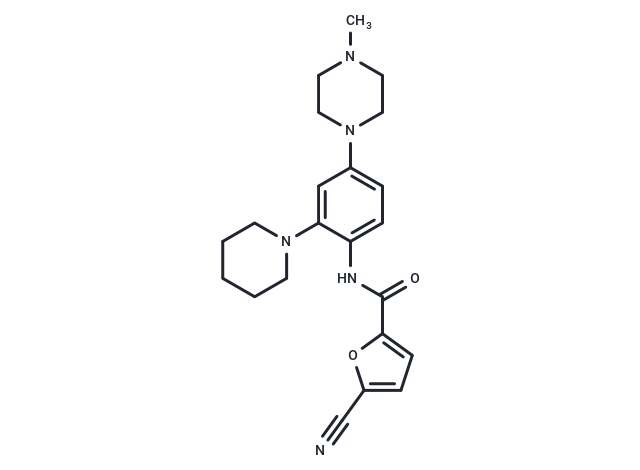
c-Fms-IN-1
CAS No. 885703-64-0
c-Fms-IN-1( —— )
Catalog No. M32824 CAS No. 885703-64-0
c-Fms-IN-1 is an inhibitor of c-FMS kinase (IC50 = 0.8 nM).
Purity : >98% (HPLC)
 COA
Datasheet
HNMR
HPLC
MSDS
Handing Instructions
COA
Datasheet
HNMR
HPLC
MSDS
Handing Instructions
| Size | Price / USD | Stock | Quantity |
| 1 mL x 10 mM in DMSO | 62 | In Stock |


|
| 2MG | 33 | In Stock |
|
| 5MG | 56 | In Stock |
|
| 10MG | 93 | In Stock |
|
| 25MG | 170 | In Stock |
|
| 50MG | 261 | In Stock |
|
| 100MG | 379 | In Stock |
|
| 200MG | Get Quote | In Stock |
|
| 500MG | Get Quote | In Stock |
|
| 1G | Get Quote | In Stock |
|
Biological Information
-
Product Namec-Fms-IN-1
-
NoteResearch use only, not for human use.
-
Brief Descriptionc-Fms-IN-1 is an inhibitor of c-FMS kinase (IC50 = 0.8 nM).
-
Descriptionc-Fms-IN-1 is a FMS kinase inhibitor with an IC50 of 0.0008 μM.
-
In Vitro——
-
In Vivo——
-
Synonyms——
-
PathwayTyrosine Kinase
-
TargetCSF1R
-
Recptorc-Fms
-
Research Area——
-
Indication——
Chemical Information
-
CAS Number885703-64-0
-
Formula Weight393.48
-
Molecular FormulaC22H27N5O2
-
Purity>98% (HPLC)
-
SolubilityIn Vitro:?DMSO : 5 mg/mL (12.71 mM; Ultrasonic )
-
SMILESCN1CCN(CC1)c1ccc(NC(=O)c2ccc(o2)C#N)c(c1)N1CCCCC1
-
Chemical Name——
Shipping & Storage Information
-
Storage(-20℃)
-
ShippingWith Ice Pack
-
Stability≥ 2 years
Reference
1. Illig CR, et al. Discovery of novel FMS kinase inhibitors as anti-inflammatory agents. Bioorg Med Chem Lett. 2008 Mar 1;18(5):1642-8.?
molnova catalog



related products
-
Ki20227
A potent, selective, orally active c-Fms inhibitor with IC50 of 2 nM.
-
Chiauranib
Chiauranib is a multi-target inhibitor against tumor angiogenesis and exhibits potent anticancer effects.
-
cFMS Receptor Inhibi...
cFMS Receptor Inhibitor IV is an inhibitor of c-Fms tyrosine kinase.
