


 Cart
 sales@molnova.com


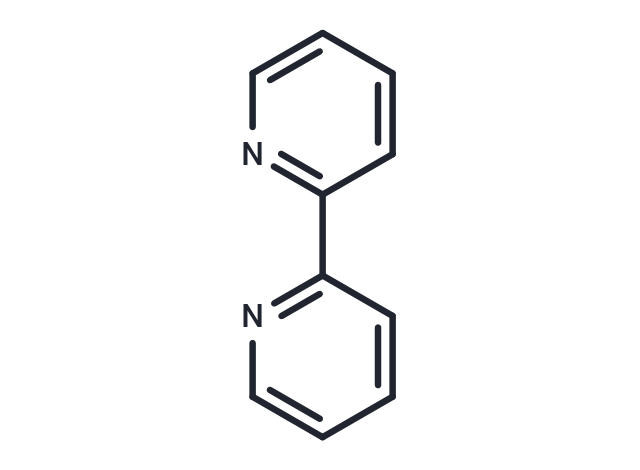
2,2-Bipyridine
CAS No. 366-18-7
2,2-Bipyridine( —— )
Catalog No. M32719 CAS No. 366-18-7
2,2'-Bipyridine is a unique bioactive natural product molecular scaffold commonly used in the core structure of many chelating ligands.
Purity : >98% (HPLC)
 COA
Datasheet
HNMR
HPLC
MSDS
Handing Instructions
| Size | Price / USD | Stock | Quantity |
| 1 mL x 10 mM in DMSO | 37 | In Stock |


|
| 100MG | Get Quote | In Stock |
|
| 200MG | 39 | In Stock |
|
| 500MG | 68 | In Stock |
|
| 1G | 91 | In Stock |
|
Biological Information
-
Product Name2,2-Bipyridine
-
NoteResearch use only, not for human use.
-
Brief Description2,2'-Bipyridine is a unique bioactive natural product molecular scaffold commonly used in the core structure of many chelating ligands.
-
Description2,2'-Bipyridine is the unique molecular scaffold of the bioactive natural products. 2,2'-Bipyridine is extensively used as the core structure of many chelating ligands by acting as a bridge in the arrangement of the catalytic center. 2,2'-Bipyridine shows robust redox stability and hyperglycemic activity.
-
In Vitro——
-
In VivoDosage:40 mg/kg Administration:Subcutaneous injection; once.Result:Showed hyperglycemic activity.
-
Synonyms——
-
PathwayOthers
-
TargetOther Targets
-
RecptorOthers
-
Research Area——
-
Indication——
Chemical Information
-
CAS Number366-18-7
-
Formula Weight156.188
-
Molecular FormulaC10H8N2
-
Purity>98% (HPLC)
-
SolubilityIn Vitro:?DMSO : 100 mg/mL (640.29 mM; Ultrasonic (<60°C))
-
SMILESC1=CN=C(C=C1)C1=NC=CC=C1
-
Chemical Name——
Shipping & Storage Information
-
Storage(-20℃)
-
ShippingWith Ice Pack
-
Stability≥ 2 years
Reference



-
Cajanin
Cajanin has potential hypolipidemic effects,possibly via up-regulating the ABCA1 protein expression,subsequently resulting in increased macrophage cholesterol efflux and RCT, it can significantly improve basal glucose uptake in HepG2 cells, its improving effect is concentration dependent, it exhibits effects stronger than that of rosiglitazone, which has been used as an antidiabetic drug.
-
Apoptozole
Apoptozole is an inhibitor of the ATPase domain of Hsc70 and Hsp70, and can induce apoptosis.
-
5-Desmethylsinenseti...
5-desmethylsinensetin is a natural product isolated from Stevia satureiifolia var. satureiifolia with antiprotozoal activity, 5-desmethylsinensetin shows IC50 values of 0.4 μg/mL on T. cruzi epimastigotes and 75.1 μg/mL on trypomastigotes, respectively.
