


 Cart
Cart
 sales@molnova.com


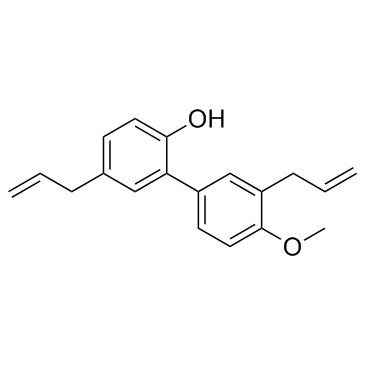
4-O-Methylhonokiol
CAS No. 68592-15-4
4-O-Methylhonokiol( —— )
Catalog No. M32611 CAS No. 68592-15-4
4-O-Methyl honokiol, a natural neolignan isolated from Magnolia officinalis, acts as a PPARγ agonist and inhibits NF-κB activity, used for cancer and inflammation research.
Purity : >98% (HPLC)
 COA
Datasheet
HNMR
HPLC
MSDS
Handing Instructions
COA
Datasheet
HNMR
HPLC
MSDS
Handing Instructions
| Size | Price / USD | Stock | Quantity |
| 1 mL x 10 mM in DMSO | 126 | In Stock |


|
| 5MG | 117 | In Stock |
|
| 10MG | 187 | In Stock |
|
| 25MG | 354 | In Stock |
|
| 50MG | 517 | In Stock |
|
| 100MG | 742 | In Stock |
|
| 200MG | Get Quote | In Stock |
|
| 500MG | 1535 | In Stock |
|
| 1G | Get Quote | In Stock |
|
Biological Information
-
Product Name4-O-Methylhonokiol
-
NoteResearch use only, not for human use.
-
Brief Description4-O-Methyl honokiol, a natural neolignan isolated from Magnolia officinalis, acts as a PPARγ agonist and inhibits NF-κB activity, used for cancer and inflammation research.
-
Description4-O-Methyl honokiol, a natural neolignan isolated from Magnolia officinalis, acts as a PPARγ agonist and inhibits NF-κB activity, used for cancer and inflammation research.
-
In Vitro4-O-Methyl honokiol is a natural neolignan isolated from Magnolia officinalis, acts as a PPARγ agonist, and inhibtis NF-κB activity. 4-O-Methyl honokiol (20 μM) increases the expression, transcription and DNA binding activities, and nuclear translocation of PPARγ in both in prostate PC-3 and LNCap cells. 4-O-Methyl honokiol (0-30 μM) inhibits LNCaP and PC-3 cancer cells growth, causes G0/G1 phase arrest and induces apoptotic cell death, and such effects can be reversed by PPARγ antagonist. 4-O-Methyl honokiol inhibits NF-κB activity and cancer cell growth, but such effects as well as its activation of PPARγ can be abolished by knock-down of p21. 4-O-methylhonokiol (0.5, 1 and 2 μM) reduces LPS-induced release of NO, PGE2, ROS, TNF-α and IL-1β in cultured astrocytes, and amyloidogenesis in cultured astrocytes and microglial BV-2 cells.
-
In Vivo4-O-Methyl honokiol (40 or 80 mg/kg, i.p. everyday for 4 weeks) inhibits the growth of SW620 and PC3 tumours in SW620 and PC3 xenograft model. 4-O-Methyl honokiol significantly increases the expression of p21 and PPARγ in the tumour tissues. 4-O-Methyl honokiol (0.5 or 1 mg/kg/day daily for 3 weeks) significantly ameliorates LPS-induced memory impairment, and inhibits LPS-induced iNOS and COX-2 expression in mice. 4-O-Methyl honokiol also shows inhibitory activities against the Aβ1-42 accumulation, and activates astrocytes and microglia in LPS-injected mice brain.
-
Synonyms——
-
PathwayOthers
-
TargetOther Targets
-
Recptor——
-
Research Area——
-
Indication——
Chemical Information
-
CAS Number68592-15-4
-
Formula Weight280.4
-
Molecular FormulaC19H20O2
-
Purity>98% (HPLC)
-
SolubilityIn Vitro:?DMSO : 100 mg/mL (356.68 mM)
-
SMILES——
-
Chemical Name——
Shipping & Storage Information
-
Storage(-20℃)
-
ShippingWith Ice Pack
-
Stability≥ 2 years
Reference
molnova catalog



related products
-
S107
S107 is a RyR-selective 1, 4-benzothiazepine derivative that stabilizes RyR2 channels by enhancing the binding affinity of calstabin2 to mutant and/or PKA-phosphorylated channels.
-
Cbz-NH-PEG1-CH2COOH
Cbz-NH-PEG1-CH2COOH is a PEG-based PROTAC linker that can be used in the synthesis of PROTACs.
-
Rotundifuran
Rotundifuran is extracted from the fruit of Vitex rotundifolia. Rotundifuran inhibits cell cycle progression and induces apoptosis in human myeloid leukemia cells.
