


 Cart
Cart
 sales@molnova.com


 Home -
Products -
Others -
Other Targets -
2,3-dihydro-3,5,7-trihydroxy-3-[(4-methoxyphenyl)methyl]-(R)-4H-1-Benzopyran-4-one
Home -
Products -
Others -
Other Targets -
2,3-dihydro-3,5,7-trihydroxy-3-[(4-methoxyphenyl)methyl]-(R)-4H-1-Benzopyran-4-one
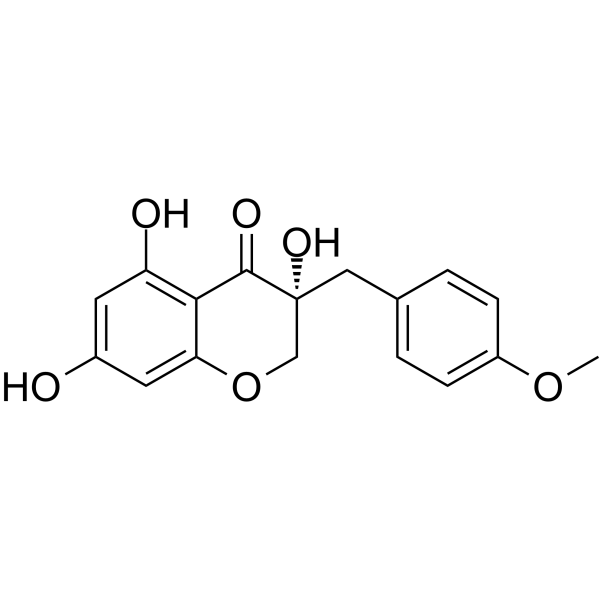
2,3-dihydro-3,5,7-trihydroxy-3-[(4-methoxyphenyl)methyl]-(R)-4H-1-Benzopyran-4-one
CAS No. 118204-64-1
2,3-dihydro-3,5,7-trihydroxy-3-[(4-methoxyphenyl)methyl]-(R)-4H-1-Benzopyran-4-one( —— )
Catalog No. M32262 CAS No. 118204-64-1
(R)-Eucomol, a flavonoid derivative, displays marginal antibacterial activity. (R)-Eucomol shows cytotoxic activity against KB and P-388 cells .
Purity : >98% (HPLC)
 COA
Datasheet
HNMR
HPLC
MSDS
Handing Instructions
COA
Datasheet
HNMR
HPLC
MSDS
Handing Instructions
| Size | Price / USD | Stock | Quantity |
| 5MG | 448 | In Stock |


|
| 50MG | Get Quote | In Stock |
|
| 100MG | Get Quote | In Stock |
|
| 200MG | Get Quote | In Stock |
|
| 500MG | Get Quote | In Stock |
|
| 1G | Get Quote | In Stock |
|
Biological Information
-
Product Name2,3-dihydro-3,5,7-trihydroxy-3-[(4-methoxyphenyl)methyl]-(R)-4H-1-Benzopyran-4-one
-
NoteResearch use only, not for human use.
-
Brief Description(R)-Eucomol, a flavonoid derivative, displays marginal antibacterial activity. (R)-Eucomol shows cytotoxic activity against KB and P-388 cells .
-
Description(R)-Eucomol, a flavonoid derivative, displays marginal antibacterial activity. (R)-Eucomol shows cytotoxic activity against KB and P-388 cells.
-
In Vitro——
-
In Vivo——
-
Synonyms——
-
PathwayOthers
-
TargetOther Targets
-
Recptor——
-
Research Area——
-
Indication——
Chemical Information
-
CAS Number118204-64-1
-
Formula Weight316.31
-
Molecular FormulaC17H16O6
-
Purity>98% (HPLC)
-
Solubility——
-
SMILES——
-
Chemical Name——
Shipping & Storage Information
-
Storage(-20℃)
-
ShippingWith Ice Pack
-
Stability≥ 2 years
Reference
molnova catalog



related products
-
Luteolin-4-O-glucosi...
Luteolin-4'-O-glucoside is an IL-5 inhibitor with an IC50 of 3.7 μM. Luteolin-4'-O-glucoside resists hyperuricemia and acute gouty arthritis activity. Luteolin-4'-O-glucoside shows anticancer activity.
-
[Pro18, Asp21] β - A...
[Pro18, Asp21] β - Amyloid (17 - 21), iAb5
-
L-γ-Glutamyl-S -[[4-...
L-γ-Glutamyl-S -[[4-(β-D-glucopyranosyloxy)phenyl]methyl]-L-cysteinylglycine
