


 Cart
Cart
 sales@molnova.com


 Home -
Products -
Others -
Other Targets -
3-(beta-D-Glucopyranosyloxy)-1,6-dihydroxy-2-methyl-9,10-anthracenedione
Home -
Products -
Others -
Other Targets -
3-(beta-D-Glucopyranosyloxy)-1,6-dihydroxy-2-methyl-9,10-anthracenedione
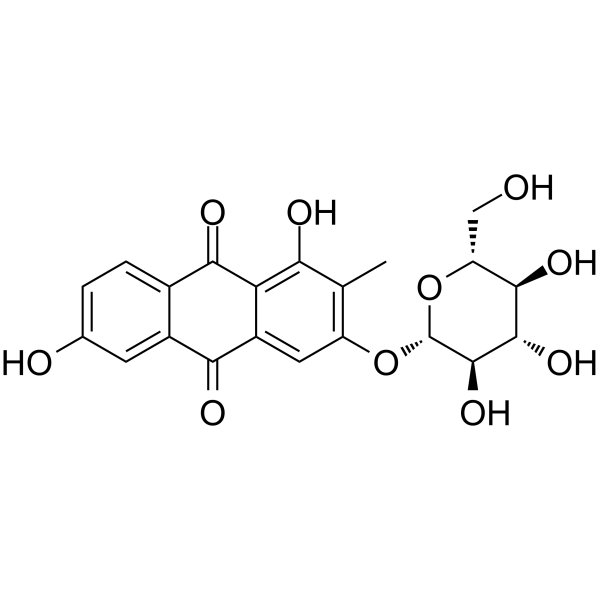
3-(beta-D-Glucopyranosyloxy)-1,6-dihydroxy-2-methyl-9,10-anthracenedione
CAS No. 125906-49-2
3-(beta-D-Glucopyranosyloxy)-1,6-dihydroxy-2-methyl-9,10-anthracenedione( —— )
Catalog No. M32258 CAS No. 125906-49-2
3-(β-D-Glucopyranosyloxy)-1,6-dihydroxy-2-methyl-9,10-anthracenedione, also known as an anthraquinone, has been specifically extracted from Rubia cordifolia.
Purity : >98% (HPLC)
 COA
Datasheet
HNMR
HPLC
MSDS
Handing Instructions
COA
Datasheet
HNMR
HPLC
MSDS
Handing Instructions
| Size | Price / USD | Stock | Quantity |
| 5MG | 358 | In Stock |


|
| 50MG | Get Quote | In Stock |
|
| 100MG | Get Quote | In Stock |
|
| 200MG | Get Quote | In Stock |
|
| 500MG | Get Quote | In Stock |
|
| 1G | Get Quote | In Stock |
|
Biological Information
-
Product Name3-(beta-D-Glucopyranosyloxy)-1,6-dihydroxy-2-methyl-9,10-anthracenedione
-
NoteResearch use only, not for human use.
-
Brief Description3-(β-D-Glucopyranosyloxy)-1,6-dihydroxy-2-methyl-9,10-anthracenedione, also known as an anthraquinone, has been specifically extracted from Rubia cordifolia.
-
Description3-(β-D-Glucopyranosyloxy)-1,6-dihydroxy-2-methyl-9,10-anthracenedione, also known as an anthraquinone, has been specifically extracted from Rubia cordifolia.
-
In Vitro——
-
In Vivo——
-
Synonyms——
-
PathwayOthers
-
TargetOther Targets
-
Recptor——
-
Research Area——
-
Indication——
Chemical Information
-
CAS Number125906-49-2
-
Formula Weight432.38
-
Molecular FormulaC21H20O10
-
Purity>98% (HPLC)
-
Solubility——
-
SMILES——
-
Chemical Name——
Shipping & Storage Information
-
Storage(-20℃)
-
ShippingWith Ice Pack
-
Stability≥ 2 years
Reference
molnova catalog



related products
-
3beta,7beta,15beta-t...
3beta,7beta,15beta-trihydroxy-11-oxo-lanosta-8-en-24->20 lactone is a natural product.
-
Cholecystokinin Octa...
Cholecystokinin Octapeptide (1-5) (desulfated)
-
Protopanaxatriol
Protopanaxatriol, a major ginseng constituent, is a novel PPARγ antagonist.
