


 Cart
 sales@molnova.com


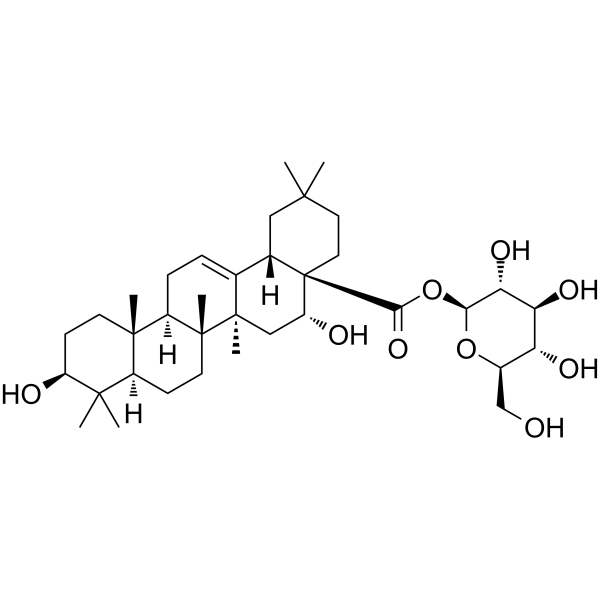
Echinocystic acid 28-O-beta-D-glucoside
CAS No. 99633-30-4
Echinocystic acid 28-O-beta-D-glucoside( —— )
Catalog No. M32229 CAS No. 99633-30-4
Echinocystic acid 28-O-β-D-glucoside is a metabolite resulting from the microbial oxidation and glucosidation of Echinocystic acid.
Purity : >98% (HPLC)
 COA
Datasheet
HNMR
HPLC
MSDS
Handing Instructions
| Size | Price / USD | Stock | Quantity |
| 5MG | 345 | In Stock |


|
| 10MG | 550 | In Stock |
|
| 25MG | 846 | In Stock |
|
| 50MG | 1135 | In Stock |
|
| 100MG | Get Quote | In Stock |
|
| 200MG | Get Quote | In Stock |
|
| 500MG | Get Quote | In Stock |
|
| 1G | Get Quote | In Stock |
|
Biological Information
-
Product NameEchinocystic acid 28-O-beta-D-glucoside
-
NoteResearch use only, not for human use.
-
Brief DescriptionEchinocystic acid 28-O-β-D-glucoside is a metabolite resulting from the microbial oxidation and glucosidation of Echinocystic acid.
-
DescriptionEchinocystic acid 28-O-β-D-glucoside is a metabolite resulting from the microbial oxidation and glucosidation of Echinocystic acid. It exhibits inhibitory activity towards the tissue factor pathway, with an IC50 value measured at 10.61 nM.
-
In VitroEchinocystic acid 28-O-β-D-glucoside inhibits tissue factor (TF) procoagulant activities in human THP-1 cells stimulated by lipopolysaccharide, with an IC50 of 10.61 nM.
-
In Vivo——
-
Synonyms——
-
PathwayOthers
-
TargetOther Targets
-
Recptor——
-
Research Area——
-
Indication——
Chemical Information
-
CAS Number99633-30-4
-
Formula Weight634.84
-
Molecular FormulaC36H58O9
-
Purity>98% (HPLC)
-
Solubility——
-
SMILES——
-
Chemical Name——
Shipping & Storage Information
-
Storage(-20℃)
-
ShippingWith Ice Pack
-
Stability≥ 2 years
Reference
molnova catalog



related products
-
3,5-Dibromo-4-methox...
3,5-Dibromo-4-methoxybenzoic acid was isolated from the Malagasy sponge Amphimedon sp.
-
pp60 c-src (521-533)...
Peptide corresponding to the pp60c-src carboxy terminal regulatory domain; phosphorylated at Tyr527. Binds to pp60c-src and pp60v-src at the SH2 domain, suppressing their tyrosine kinase activity and transforming potential.
-
HPPE
HPPE is a selective inhibitor of Bach1 that acts non-electrophilically. HPPE targets the heme-binding sites on the Bach1 protein and leads to the alleviation of Bach1-mediated repression.
