


 Cart
Cart
 sales@molnova.com


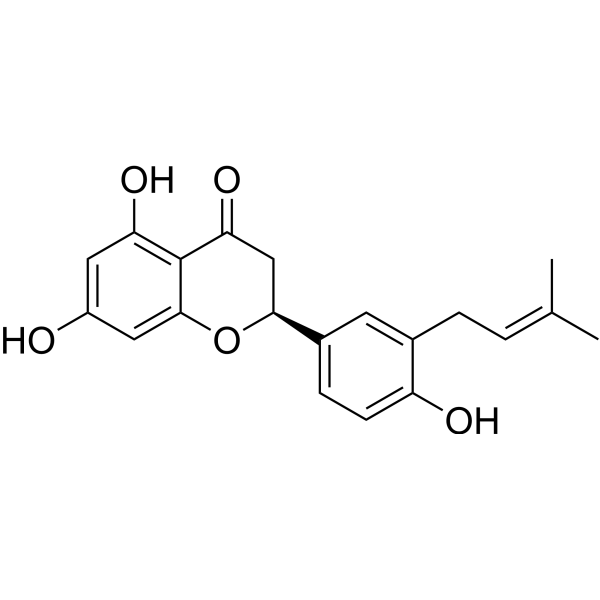
Licoflavanone
CAS No. 119240-82-3
Licoflavanone( —— )
Catalog No. M31980 CAS No. 119240-82-3
Licoflavanone exhibits antioxidant and anti-inflammatory activities,it markedly decreases pro-inflammatory cytokines and cyclooxygenase 2/inducible nitric oxide synthase (COX-2/iNOS) expression levels.
Purity : >98% (HPLC)
 COA
Datasheet
HNMR
HPLC
MSDS
Handing Instructions
COA
Datasheet
HNMR
HPLC
MSDS
Handing Instructions
| Size | Price / USD | Stock | Quantity |
| 5MG | 655 | In Stock |


|
| 50MG | Get Quote | In Stock |
|
| 100MG | Get Quote | In Stock |
|
| 200MG | Get Quote | In Stock |
|
| 500MG | Get Quote | In Stock |
|
| 1G | Get Quote | In Stock |
|
Biological Information
-
Product NameLicoflavanone
-
NoteResearch use only, not for human use.
-
Brief DescriptionLicoflavanone exhibits antioxidant and anti-inflammatory activities,it markedly decreases pro-inflammatory cytokines and cyclooxygenase 2/inducible nitric oxide synthase (COX-2/iNOS) expression levels.
-
DescriptionLicoflavanone exhibits antioxidant and anti-inflammatory activities,it markedly decreases pro-inflammatory cytokines and cyclooxygenase 2/inducible nitric oxide synthase (COX-2/iNOS) expression levels.
-
In Vitro——
-
In Vivo——
-
Synonyms——
-
PathwayOthers
-
TargetOther Targets
-
Recptor——
-
Research Area——
-
Indication——
Chemical Information
-
CAS Number119240-82-3
-
Formula Weight340.4
-
Molecular FormulaC20H20O5
-
Purity>98% (HPLC)
-
Solubility——
-
SMILES——
-
Chemical Name——
Shipping & Storage Information
-
Storage(-20℃)
-
ShippingWith Ice Pack
-
Stability≥ 2 years
Reference
molnova catalog



related products
-
α-MSH (11-13) · 2 HC...
α-MSH (11-13) · 2 HCl
-
Lucidin
Lucidin and its derivatives are genotoxic, it is mutagenic at the hypoxanthine-guanine phosphoribosyl transferase gene locus.
-
1-(3,4-dimethoxyphen...
1-(3,4-Dimethoxyphenyl)-2-(4-allly-2,6-dimethoxyphenoxy)propan-1-ol shows anti-staphylococcal activity against a total of five multidrug-resistant (MDR) and methicillin-resistant Staphylococcus aureus strains and the minimum inhibitory concentrations (MICs) are in the range of 128-256 ug/ml.
