


 Cart
Cart
 sales@molnova.com


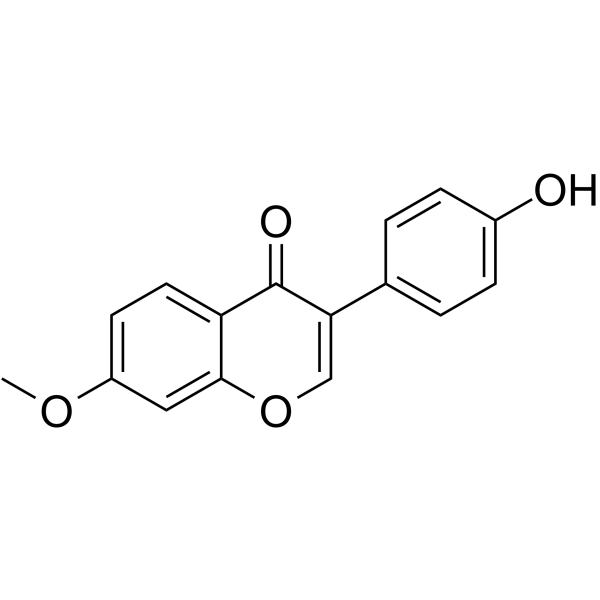
Isoformononetin
CAS No. 486-63-5
Isoformononetin( —— )
Catalog No. M31705 CAS No. 486-63-5
Isoformononetin shows fungitoxic activity against Cladosporium sphaerospermum; it also has immunomodulatory activity, it inhibits the differentiation of Th17 cells and B-cell lymphopoesis to promote osteogenesis in estrogen-deficient bone loss conditions.
Purity : >98% (HPLC)
 COA
Datasheet
HNMR
HPLC
MSDS
Handing Instructions
COA
Datasheet
HNMR
HPLC
MSDS
Handing Instructions
| Size | Price / USD | Stock | Quantity |
| 5MG | 243 | In Stock |


|
| 50MG | Get Quote | In Stock |
|
| 100MG | Get Quote | In Stock |
|
| 200MG | Get Quote | In Stock |
|
| 500MG | Get Quote | In Stock |
|
| 1G | Get Quote | In Stock |
|
Biological Information
-
Product NameIsoformononetin
-
NoteResearch use only, not for human use.
-
Brief DescriptionIsoformononetin shows fungitoxic activity against Cladosporium sphaerospermum; it also has immunomodulatory activity, it inhibits the differentiation of Th17 cells and B-cell lymphopoesis to promote osteogenesis in estrogen-deficient bone loss conditions.
-
DescriptionIsoformononetin shows fungitoxic activity against Cladosporium sphaerospermum; it also has immunomodulatory activity, it inhibits the differentiation of Th17 cells and B-cell lymphopoesis to promote osteogenesis in estrogen-deficient bone loss conditions. Isoformononetin reverses bone loss in osteopenic rats and exerts bone anabolic action by preventing osteoblast apoptosis.
-
In Vitro——
-
In Vivo——
-
Synonyms——
-
PathwayOthers
-
TargetOther Targets
-
Recptor——
-
Research Area——
-
Indication——
Chemical Information
-
CAS Number486-63-5
-
Formula Weight268.3
-
Molecular FormulaC16H12O4
-
Purity>98% (HPLC)
-
SolubilityIn Vitro:?DMSO : 250 mg/mL (931.93 mM)
-
SMILES——
-
Chemical Name——
Shipping & Storage Information
-
Storage(-20℃)
-
ShippingWith Ice Pack
-
Stability≥ 2 years
Reference
molnova catalog



related products
-
Taurocholic Acid (so...
Taurocholic acid is a bile salt formed in the liver by conjugation of cholic acid with taurine that is involved in the emulsification of lipids.1.
-
Amine-PEG3-Biotin
Amine-PEG3-Biotin can be used as a signal amplification label.
-
Guvacoline Hydrobrom...
Guvacoline hydrobromide, a pyridine alkaloid found in Areca triandra, can act as a weak full agonist of atrial and ileal mAChR.
