


 Cart
Cart
 sales@molnova.com


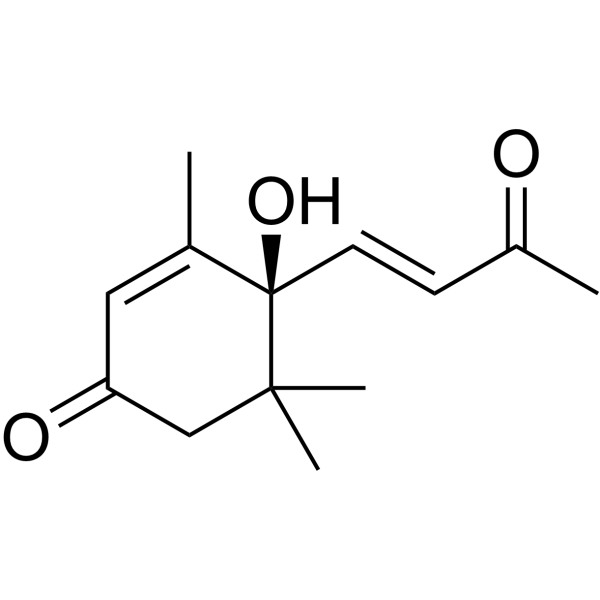
Dehydrovomifoliol
CAS No. 39763-33-2
Dehydrovomifoliol( —— )
Catalog No. M31569 CAS No. 39763-33-2
Dehydrovomifoliol could be a marker of Polish heather honey. Dehydrovomifoliol exhibits moderate acetylcholinesterase (AChE) inhibitory activities.
Purity : >98% (HPLC)
 COA
Datasheet
HNMR
HPLC
MSDS
Handing Instructions
COA
Datasheet
HNMR
HPLC
MSDS
Handing Instructions
| Size | Price / USD | Stock | Quantity |
| 5MG | 531 | In Stock |


|
| 50MG | Get Quote | In Stock |
|
| 100MG | Get Quote | In Stock |
|
| 200MG | Get Quote | In Stock |
|
| 500MG | Get Quote | In Stock |
|
| 1G | Get Quote | In Stock |
|
Biological Information
-
Product NameDehydrovomifoliol
-
NoteResearch use only, not for human use.
-
Brief DescriptionDehydrovomifoliol could be a marker of Polish heather honey. Dehydrovomifoliol exhibits moderate acetylcholinesterase (AChE) inhibitory activities.
-
DescriptionDehydrovomifoliol could be a marker of Polish heather honey. Dehydrovomifoliol exhibits moderate acetylcholinesterase (AChE) inhibitory activities. Dehydrovomifoliol shows significant cytotoxic activities against three human cancer cell lines, namely, HONE-1 nasopharyngeal, KB oral epidermoid carcinoma, and HT29 colorectal carcinoma cells, and the IC(50) values in the range 3.7-8.1 microM.
-
In Vitro——
-
In Vivo——
-
Synonyms——
-
PathwayOthers
-
TargetOther Targets
-
Recptor——
-
Research Area——
-
Indication——
Chemical Information
-
CAS Number39763-33-2
-
Formula Weight222.28
-
Molecular FormulaC13H18O3
-
Purity>98% (HPLC)
-
Solubility——
-
SMILES——
-
Chemical Name——
Shipping & Storage Information
-
Storage(-20℃)
-
ShippingWith Ice Pack
-
Stability≥ 2 years
Reference
molnova catalog



related products
-
H-Lys-Arg-Glu-Leu-Va...
H-Lys-Arg-Glu-Leu-Val-Glu-Pro-Leu-Thr-Pro-Ser-Gly-Glu-Ala-Pro-Asn-Gln-Ala-Leu-Leu-Arg-OH
-
5,6-dibromo-1H-indol...
5,6-dibromo-1H-indole-3-carbaldehyde is a marine derived natural products found in Smenospongia sp.
-
Angelol B
The absorption and transport of angelol A and Angelol B are passive diffusion as the dominating process in Caco-2 cell monolayer model.
