


 Cart
 sales@molnova.com


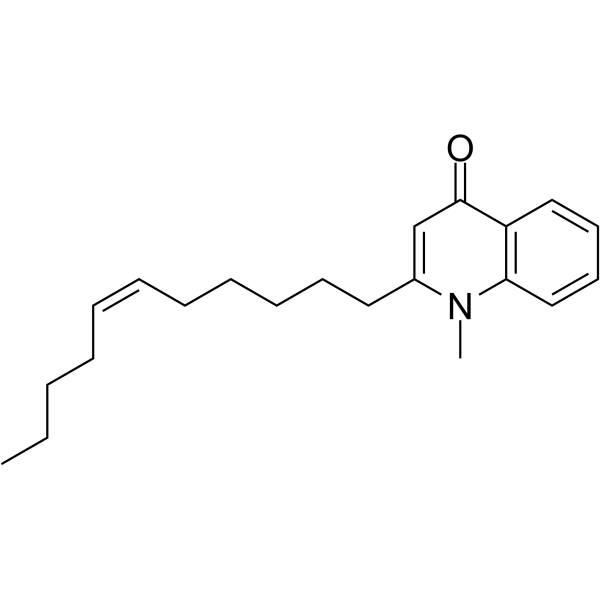
(Z)-1-Methyl-2-(undec-6-enyl)quinolin-4(1H)-one
CAS No. 120693-49-4
(Z)-1-Methyl-2-(undec-6-enyl)quinolin-4(1H)-one( —— )
Catalog No. M31537 CAS No. 120693-49-4
(Z)-1-Methyl-2-(undec-6-enyl)quinolin-4(1H)-one shows strong inhibitory activity on leukotriene biosynthesis in human polymorphonuclear granulocytes, and it is very effective against mycobacteria.
Purity : >98% (HPLC)
 COA
Datasheet
HNMR
HPLC
MSDS
Handing Instructions
| Size | Price / USD | Stock | Quantity |
| 5MG | 594 | In Stock |


|
| 50MG | Get Quote | In Stock |
|
| 100MG | Get Quote | In Stock |
|
| 200MG | Get Quote | In Stock |
|
| 500MG | Get Quote | In Stock |
|
| 1G | Get Quote | In Stock |
|
Biological Information
-
Product Name(Z)-1-Methyl-2-(undec-6-enyl)quinolin-4(1H)-one
-
NoteResearch use only, not for human use.
-
Brief Description(Z)-1-Methyl-2-(undec-6-enyl)quinolin-4(1H)-one shows strong inhibitory activity on leukotriene biosynthesis in human polymorphonuclear granulocytes, and it is very effective against mycobacteria.
-
Description(Z)-1-Methyl-2-(undec-6-enyl)quinolin-4(1H)-one shows strong inhibitory activity on leukotriene biosynthesis in human polymorphonuclear granulocytes, and it is very effective against mycobacteria.
-
In Vitro1-Methyl-2-[(Z)-6-undecenyl]-4(1H)-quinolone is a quinolone alkaloid isolated from the fruit of Evodia rutaecarpa BENTHAM (Rutaceae).
-
In Vivo——
-
Synonyms——
-
PathwayOthers
-
TargetOther Targets
-
Recptor——
-
Research Area——
-
Indication——
Chemical Information
-
CAS Number120693-49-4
-
Formula Weight311.46
-
Molecular FormulaC21H29NO
-
Purity>98% (HPLC)
-
Solubility——
-
SMILES——
-
Chemical Name——
Shipping & Storage Information
-
Storage(-20℃)
-
ShippingWith Ice Pack
-
Stability≥ 2 years
Reference
molnova catalog


related products
-
Antioxidant peptide ...
Antioxidant peptide A is a short peptide, which contains alternative aromatic or sulfur-containing amino acid.
-
[D-Ser13]-Somatostat...
[D-Ser13]-Somatostatin-14
-
DI-N-OCTYL PHTHALATE
Phthalate ester used as plasticizers and additives. Used in toxicology studies as well as risk assessment studies of food contamination that occurs via migration of phthalates into foodstuffs from food-contact materials (FCM).
