


 Cart
Cart
 sales@molnova.com


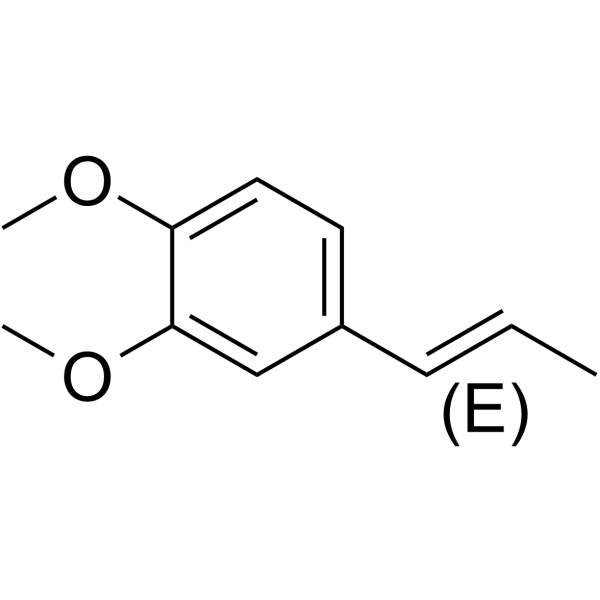
trans-Methylisoeugenol
CAS No. 6379-72-2
trans-Methylisoeugenol( —— )
Catalog No. M31483 CAS No. 6379-72-2
Trans-Methylisoeugenol is a compound with insecticidal activity isolated from Acorus calamus L. It is a natural food flavor.
Purity : >98% (HPLC)
 COA
Datasheet
HNMR
HPLC
MSDS
Handing Instructions
COA
Datasheet
HNMR
HPLC
MSDS
Handing Instructions
| Size | Price / USD | Stock | Quantity |
| 1 mL x 10 mM in DMSO | 200 | In Stock |


|
| 5MG | 186 | In Stock |
|
| 10MG | 280 | In Stock |
|
| 100MG | Get Quote | In Stock |
|
| 200MG | Get Quote | In Stock |
|
| 500MG | Get Quote | In Stock |
|
| 1G | Get Quote | In Stock |
|
Biological Information
-
Product Nametrans-Methylisoeugenol
-
NoteResearch use only, not for human use.
-
Brief DescriptionTrans-Methylisoeugenol is a compound with insecticidal activity isolated from Acorus calamus L. It is a natural food flavor.
-
DescriptionTrans-Methylisoeugenol is a compound with insecticidal activity isolated from Acorus calamus L. It is a natural food flavor. It is a natural food flavor with anxiolytic and antidepressant properties and moderately reversible inhibition of glutathione S-transferases (GSTs) (0.2 to 5.4 mmol for human GSTs and 0.4 to 4.9 mmol for rat GSTs).
-
In Vitro——
-
In Vivo——
-
Synonyms——
-
PathwayOthers
-
TargetOther Targets
-
Recptor——
-
Research Area——
-
Indication——
Chemical Information
-
CAS Number6379-72-2
-
Formula Weight178.2
-
Molecular FormulaC11H14O2
-
Purity>98% (HPLC)
-
Solubility——
-
SMILES——
-
Chemical Name——
Shipping & Storage Information
-
Storage(-20℃)
-
ShippingWith Ice Pack
-
Stability≥ 2 years
Reference
molnova catalog



related products
-
SPR741 TFA
SPR741 TFA (NAB741 TFA) is a cationic peptide derived from polymyxin B and is a potentiator molecule.
-
SAR405 R enantiomer
SAR405 R enantiomer is the less active enantiomer of SAR405. SAR405 is an inhibitor of PIK3C3/Vps34.
-
Undecenoic acid
Undecylenic acid is an organic unsaturated fatty acid pyrolysis product of ricinoleic acid from castor oil.
