


 Cart
Cart
 sales@molnova.com


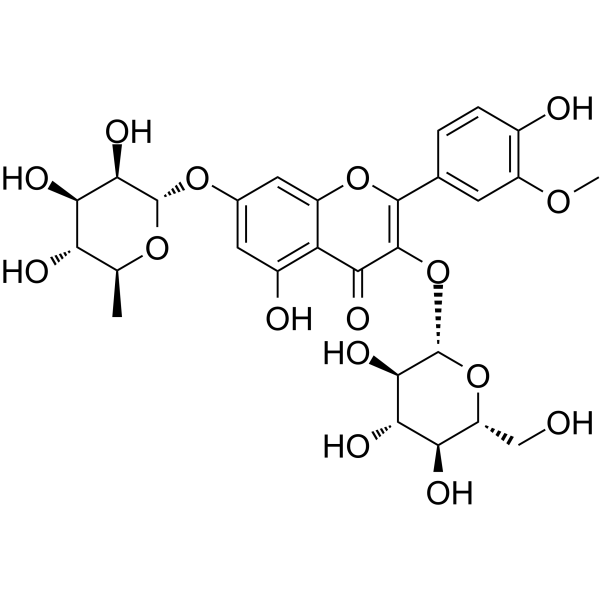
Isorhamnetin 3-glucoside-7-rhamnoside
CAS No. 17331-71-4
Isorhamnetin 3-glucoside-7-rhamnoside( —— )
Catalog No. M31401 CAS No. 17331-71-4
An anti-oxidative composition containing isorhamnetin-3-glucoside-7-rhamnoside (IGR)isolated from Hippophae rhamnoides L. is provided to ensure antioxidative, antibacterial, and anti-cancer effect.
Purity : >98% (HPLC)
 COA
Datasheet
HNMR
HPLC
MSDS
Handing Instructions
COA
Datasheet
HNMR
HPLC
MSDS
Handing Instructions
| Size | Price / USD | Stock | Quantity |
| 5MG | 574 | In Stock |


|
| 50MG | Get Quote | In Stock |
|
| 100MG | Get Quote | In Stock |
|
| 200MG | Get Quote | In Stock |
|
| 500MG | Get Quote | In Stock |
|
| 1G | Get Quote | In Stock |
|
Biological Information
-
Product NameIsorhamnetin 3-glucoside-7-rhamnoside
-
NoteResearch use only, not for human use.
-
Brief DescriptionAn anti-oxidative composition containing isorhamnetin-3-glucoside-7-rhamnoside (IGR)isolated from Hippophae rhamnoides L. is provided to ensure antioxidative, antibacterial, and anti-cancer effect.
-
DescriptionAn anti-oxidative composition containing isorhamnetin-3-glucoside-7-rhamnoside (IGR)isolated from Hippophae rhamnoides L. is provided to ensure antioxidative, antibacterial, and anti-cancer effect.
-
In Vitro——
-
In Vivo——
-
Synonyms——
-
PathwayOthers
-
TargetOther Targets
-
Recptor——
-
Research Area——
-
Indication——
Chemical Information
-
CAS Number17331-71-4
-
Formula Weight624.54
-
Molecular FormulaC28H32O16
-
Purity>98% (HPLC)
-
Solubility——
-
SMILES——
-
Chemical Name——
Shipping & Storage Information
-
Storage(-20℃)
-
ShippingWith Ice Pack
-
Stability≥ 2 years
Reference
molnova catalog



related products
-
MEISi-2
MEISi-2 is a potent MEIS inhibitor (MEISi). MEISi-2 significantly inhibits MEIS-luciferase reporters in vitro.
-
p-Cresol
p-Cresol (4-methylphenol) is a partially lipophilic moiety which strongly binds to plasma protein (close to 100%) under normal conditions. p-Cresol is metabolized through conjugation mainly sulphation and glucuronization but removal of the unconjugated p-cresol is at least in part via the urine.
-
K-Ras(G12C) Inhibito...
K-Ras(G12C) inhibitor 6 is an irreversible, allosteric inhibitor of the K-Ras(G12C) mutant that causes 100% modification of the protein when used at 10 μM for 24 hours in vitro.
