


 Cart
Cart
 sales@molnova.com


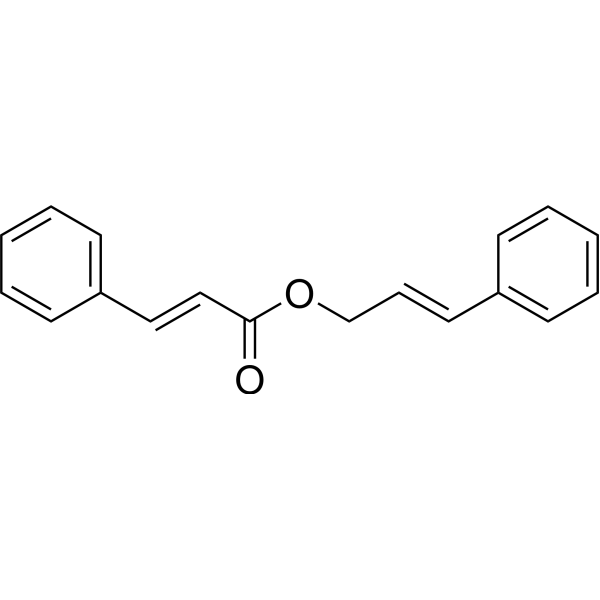
Cinnamyl cinnamate
CAS No. 122-69-0
Cinnamyl cinnamate( —— )
Catalog No. M31164 CAS No. 122-69-0
Cinnamyl cinnamate is a natural product that is present in dipterocarpus and poplar. Cinnamyl cinnamate is the fragrance that can be extracted from Suhe balsam and white Peru balsam.
Purity : >98% (HPLC)
 COA
Datasheet
HNMR
HPLC
MSDS
Handing Instructions
COA
Datasheet
HNMR
HPLC
MSDS
Handing Instructions
| Size | Price / USD | Stock | Quantity |
| 1 mL x 10 mM in DMSO | 33 | In Stock |


|
| 25MG | 29 | In Stock |
|
| 50MG | 33 | In Stock |
|
| 100MG | 54 | In Stock |
|
| 200MG | Get Quote | In Stock |
|
| 500MG | 144 | In Stock |
|
| 1G | Get Quote | In Stock |
|
Biological Information
-
Product NameCinnamyl cinnamate
-
NoteResearch use only, not for human use.
-
Brief DescriptionCinnamyl cinnamate is a natural product that is present in dipterocarpus and poplar. Cinnamyl cinnamate is the fragrance that can be extracted from Suhe balsam and white Peru balsam.
-
DescriptionCinnamyl cinnamate is a natural product that is present in dipterocarpus and poplar. Cinnamyl cinnamate is the fragrance that can be extracted from Suhe balsam and white Peru balsam.
-
In Vitro——
-
In Vivo——
-
Synonyms——
-
PathwayOthers
-
TargetOther Targets
-
Recptor——
-
Research Area——
-
Indication——
Chemical Information
-
CAS Number122-69-0
-
Formula Weight264.32
-
Molecular FormulaC18H16O2
-
Purity>98% (HPLC)
-
Solubility——
-
SMILES——
-
Chemical Name——
Shipping & Storage Information
-
Storage(-20℃)
-
ShippingWith Ice Pack
-
Stability≥ 2 years
Reference
molnova catalog



related products
-
Cinromide
Cinromide (3-bromo-N-ethylcinnanamide) is used as novel anticonvulsant agent.
-
Sarolaner
Sarolaner is an orally active and broad-spectrum ectoparasiticide (LC80: 0.3 μg/mL against C. felis and an LC100: 0.003 μg/mL against O. turicata).
-
IL-1β (178-207) (hum...
IL-1β (178-207) (human)
