


 Cart
Cart
 sales@molnova.com


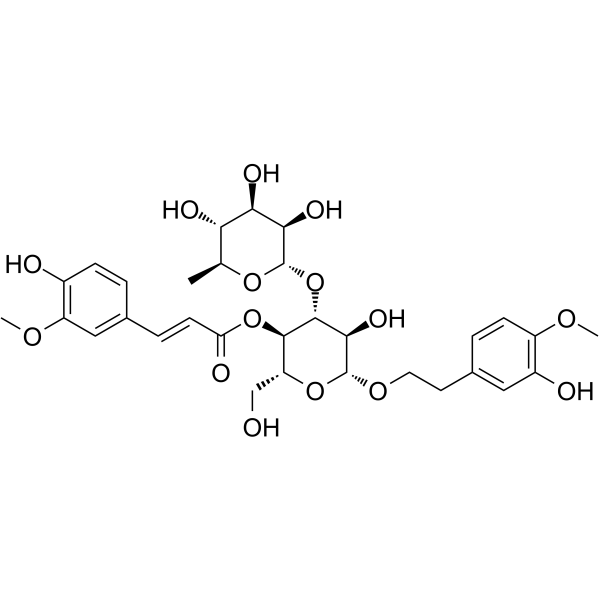
Martynoside
CAS No. 67884-12-2
Martynoside( —— )
Catalog No. M31043 CAS No. 67884-12-2
Martynoside is a natural selective estrogen receptor modulator, which has antioxidative, anti-muscle fatigue, anticancer and antimetastatic activities.
Purity : >98% (HPLC)
 COA
Datasheet
HNMR
HPLC
MSDS
Handing Instructions
COA
Datasheet
HNMR
HPLC
MSDS
Handing Instructions
| Size | Price / USD | Stock | Quantity |
| 5MG | 353 | In Stock |


|
| 10MG | 566 | In Stock |
|
| 25MG | 886 | In Stock |
|
| 50MG | 1163 | In Stock |
|
| 100MG | Get Quote | In Stock |
|
| 200MG | Get Quote | In Stock |
|
| 500MG | Get Quote | In Stock |
|
| 1G | Get Quote | In Stock |
|
Biological Information
-
Product NameMartynoside
-
NoteResearch use only, not for human use.
-
Brief DescriptionMartynoside is a natural selective estrogen receptor modulator, which has antioxidative, anti-muscle fatigue, anticancer and antimetastatic activities.
-
DescriptionMartynoside is a natural selective estrogen receptor modulator, which has antioxidative, anti-muscle fatigue, anticancer and antimetastatic activities. Martynoside has the potential of antagonizing sports anaemia, the mechanism of this effect might be related to preventing RBC from free radical damage.
-
In Vitro——
-
In Vivo——
-
Synonyms——
-
PathwayOthers
-
TargetOther Targets
-
Recptor——
-
Research Area——
-
Indication——
Chemical Information
-
CAS Number67884-12-2
-
Formula Weight652.7
-
Molecular FormulaC31H40O15
-
Purity>98% (HPLC)
-
SolubilityIn Vitro:?DMSO : 25 mg/mL (38.31 mM)
-
SMILES——
-
Chemical Name——
Shipping & Storage Information
-
Storage(-20℃)
-
ShippingWith Ice Pack
-
Stability≥ 2 years
Reference
molnova catalog



related products
-
Bis(2-chloroethyl)am...
Pharmaceutical Intermediates
-
GLYCODEOXYCHOLIC ACI...
Glycodeoxycholic Acid is a bile acid that induces severe pancreatitis in rats. It can induce the apoptosis of SMMC-7721 cells.
-
Kuwanon T
Kuwanon T is an isoprenylated flavonoid compound isolated from the root bark of Morus alba. Kuwanon T shows protective effects on t-BHP-induced oxidative stress with a EC50 of 30.32 μM.
