


 Cart
Cart
 sales@molnova.com


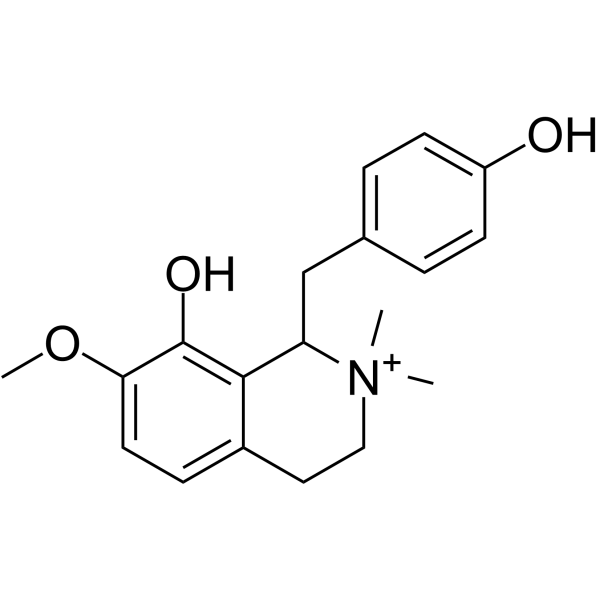
Oblongine
CAS No. 60008-01-7
Oblongine( —— )
Catalog No. M31010 CAS No. 60008-01-7
Oblongine chloride may have potential haemodynamic effects, it can cause a dose-dependent reduction of systolic and diastolic blood pressure, and that these effects are not mediated by α2-adrenergic receptor stimulation.
Purity : >98% (HPLC)
 COA
Datasheet
HNMR
HPLC
MSDS
Handing Instructions
COA
Datasheet
HNMR
HPLC
MSDS
Handing Instructions
| Size | Price / USD | Stock | Quantity |
| 5MG | 531 | In Stock |


|
| 50MG | Get Quote | In Stock |
|
| 100MG | Get Quote | In Stock |
|
| 200MG | Get Quote | In Stock |
|
| 500MG | Get Quote | In Stock |
|
| 1G | Get Quote | In Stock |
|
Biological Information
-
Product NameOblongine
-
NoteResearch use only, not for human use.
-
Brief DescriptionOblongine chloride may have potential haemodynamic effects, it can cause a dose-dependent reduction of systolic and diastolic blood pressure, and that these effects are not mediated by α2-adrenergic receptor stimulation.
-
DescriptionOblongine chloride may have potential haemodynamic effects, it can cause a dose-dependent reduction of systolic and diastolic blood pressure, and that these effects are not mediated by α2-adrenergic receptor stimulation.
-
In Vitro——
-
In Vivo——
-
Synonyms——
-
PathwayOthers
-
TargetOther Targets
-
Recptor——
-
Research Area——
-
Indication——
Chemical Information
-
CAS Number60008-01-7
-
Formula Weight314.4
-
Molecular FormulaC19H24NO3
-
Purity>98% (HPLC)
-
Solubility——
-
SMILES——
-
Chemical Name——
Shipping & Storage Information
-
Storage(-20℃)
-
ShippingWith Ice Pack
-
Stability≥ 2 years
Reference
molnova catalog



related products
-
Ganoderic acid Df
Ganoderic acid Df is a lanostane-type triterpenoid, that can be isolated from the fruiting body of Ganoderma lucidum. Ganoderic acid Df potently inhibits aldose reductase, with an IC50 of 22.8 ± 0.6 μM.
-
(Fmoc-Glu70,Ala71·72...
(Fmoc-Glu70,Ala71·72,Lys74)-C3a (70-77)
-
IPTG
IPTG is a non-metabolizable galactose analog that induces expression of the LAC OPERON.
