


 Cart
Cart
 sales@molnova.com


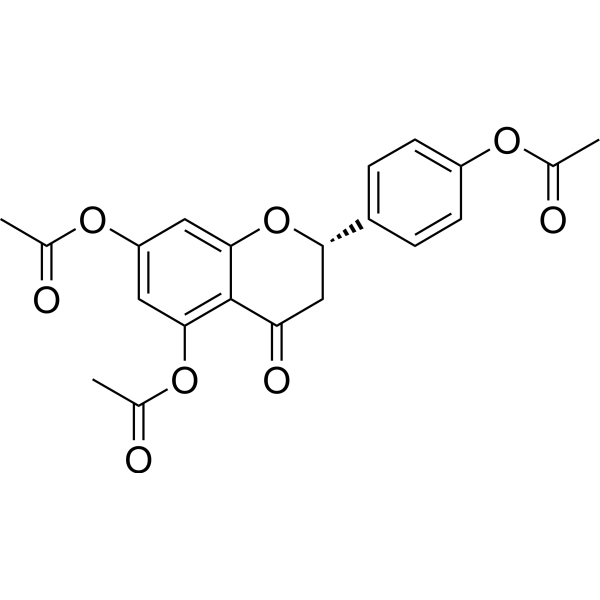
Naringenin triacetate
CAS No. 3682-04-0
Naringenin triacetate( —— )
Catalog No. M30951 CAS No. 3682-04-0
Naringenin triacetate exhibits a better binding affinity with multiple crystal structures of first bromodomain BRD4 (BRD4 BD1) when compared with the known inhibitors.
Purity : >98% (HPLC)
 COA
Datasheet
HNMR
HPLC
MSDS
Handing Instructions
COA
Datasheet
HNMR
HPLC
MSDS
Handing Instructions
| Size | Price / USD | Stock | Quantity |
| 5MG | 102 | In Stock |


|
| 10MG | 163 | In Stock |
|
| 25MG | 274 | In Stock |
|
| 50MG | 402 | In Stock |
|
| 100MG | 582 | In Stock |
|
| 200MG | 821 | In Stock |
|
| 500MG | Get Quote | In Stock |
|
| 1G | Get Quote | In Stock |
|
Biological Information
-
Product NameNaringenin triacetate
-
NoteResearch use only, not for human use.
-
Brief DescriptionNaringenin triacetate exhibits a better binding affinity with multiple crystal structures of first bromodomain BRD4 (BRD4 BD1) when compared with the known inhibitors.
-
DescriptionNaringenin triacetate exhibits a better binding affinity with multiple crystal structures of first bromodomain BRD4 (BRD4 BD1) when compared with the known inhibitors.
-
In Vitro——
-
In Vivo——
-
Synonyms——
-
PathwayOthers
-
TargetOther Targets
-
Recptor——
-
Research Area——
-
Indication——
Chemical Information
-
CAS Number3682-04-0
-
Formula Weight398.4
-
Molecular FormulaC21H18O8
-
Purity>98% (HPLC)
-
SolubilityIn Vitro:?DMSO : 100 mg/mL (251.03 mM)
-
SMILES——
-
Chemical Name——
Shipping & Storage Information
-
Storage(-20℃)
-
ShippingWith Ice Pack
-
Stability≥ 2 years
Reference
molnova catalog



related products
-
Multicaulisin
Multicaulisin is a natural product from Morus multicaulis.
-
2-Aminoacridone
2-Aminoacridone is a widely used fluorophore (λexc=428 nm, λem=525 nm).
-
ProTx III
Potent Nav1.7 blocker (IC50 = 2.5 nM). Also inhibits Nav1.1, Nav1.2, Nav1.3 and Nav1.6 in the nanomolar range. Exhibits no effects on Cav channels or nAChR at 5 μM. Demonstrates analgesic activity in vivo; antagonizes effects of scorpion-venom toxin OD1 at Nav1.7.
