


 Cart
Cart
 sales@molnova.com


CDK2
CAS No. 255064-79-0
CDK2( —— )
Catalog No. M30573 CAS No. 255064-79-0
CDK2 is a member of the eukaryotic S/T protein kinase family and its function is to catalyze the phosphoryl transfer of ATP γ-phosphate to serine or threonine hydroxyl (denoted as S0/T0) in a protein substrate.
Purity : >98% (HPLC)
 COA
Datasheet
HNMR
HPLC
MSDS
Handing Instructions
COA
Datasheet
HNMR
HPLC
MSDS
Handing Instructions
| Size | Price / USD | Stock | Quantity |
| 5MG | 392 | Get Quote |


|
| 100MG | Get Quote | Get Quote |
|
| 200MG | Get Quote | Get Quote |
|
| 500MG | Get Quote | Get Quote |
|
| 1G | Get Quote | Get Quote |
|
Biological Information
-
Product NameCDK2
-
NoteResearch use only, not for human use.
-
Brief DescriptionCDK2 is a member of the eukaryotic S/T protein kinase family and its function is to catalyze the phosphoryl transfer of ATP γ-phosphate to serine or threonine hydroxyl (denoted as S0/T0) in a protein substrate.
-
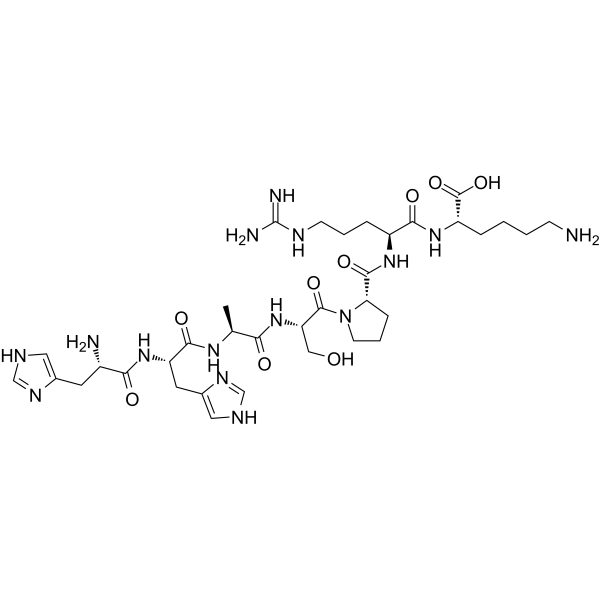
DescriptionCDK2 is a member of the eukaryotic S/T protein kinase family and its function is to catalyze the phosphoryl transfer of ATP γ-phosphate to serine or threonine hydroxyl (denoted as S0/T0) in a protein substrate.(In Vitro):CDK2 (Cyclin-dependent kinase 2) is a member of the eukaryotic S/T protein kinase family and its function is to catalyze the phosphoryl transfer of ATP γ-phosphate to serine or threonine hydroxyl (denoted as S0/T0) in a protein substrate. The fully active CDK2 is in complex with HHASPRK (an optimal peptide substrate), namely interactions of CDK2 with peptide substrate and the dynamics of the G-loop. CDK2 participates in eukaryotic cell cycle regulation at the G1/S boundary. CDK2 deregulation has been proved to occur in tumor cells, evoking a strong interest in artificial and native inhibitors. CDK2 activity is tightly regulated by a complex mechanism, including a positive regulatory subunit binding, and phosphorylations at positive and/or negative regulatory sites.
-
In VitroCDK2 (Cyclin-dependent kinase 2) is a member of the eukaryotic S/T protein kinase family and its function is to catalyze the phosphoryl transfer of ATP γ-phosphate to serine or threonine hydroxyl (denoted as S0/T0) in a protein substrate. The fully active CDK2 is in complex with HHASPRK (an optimal peptide substrate), namely interactions of CDK2 with peptide substrate and the dynamics of the G-loop. CDK2 participates in eukaryotic cell cycle regulation at the G1/S boundary. CDK2 deregulation has been proved to occur in tumor cells, evoking a strong interest in artificial and native inhibitors. CDK2 activity is tightly regulated by a complex mechanism, including a positive regulatory subunit binding, and phosphorylations at positive and/or negative regulatory sites.
-
In Vivo——
-
Synonyms——
-
PathwayOthers
-
TargetOther Targets
-
Recptor——
-
Research Area——
-
Indication——
Chemical Information
-
CAS Number255064-79-0
-
Formula Weight831.92
-
Molecular FormulaC35H57N15O9
-
Purity>98% (HPLC)
-
Solubility——
-
SMILES——
-
Chemical NameSequence:His-His-Ala-Ser-Pro-Arg-Lys
Shipping & Storage Information
-
Storage(-20℃)
-
ShippingWith Ice Pack
-
Stability≥ 2 years
Reference
Bártová I, The mechanism of inhibition of the cyclin-dependent kinase-2 as revealed by the molecular dynamics study on the complex CDK2 with the peptide substrate HHASPRK. Protein Sci. 2005 Feb;14(2):445-51.
molnova catalog



related products
-
Epidermal growth fac...
The epidermal growth factor receptor is the cell-surface receptor for members of the epidermal growth factor family of extracellular protein ligands.
-
9-O-Acetyl-fargesol
9-O-Acetyl-fargesol is a natural product for research related to life sciences.
-
Citric acid monohydr...
Citric Acid Monohydrate is a tricarboxylic acid found in citrus fruits. Citric acid is used as an excipient in pharmaceutical preparations due to its antioxidant properties. It maintains stability of active ingredients and is used as a preservative.
