


 Cart
Cart
 sales@molnova.com


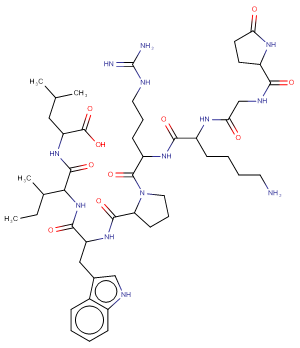
Xenopsin
CAS No. 51827-01-1
Xenopsin( —— )
Catalog No. M30444 CAS No. 51827-01-1
Xenopsin, a neurotensin-like octapeptide, Xenopsin is an inhibitor of Tetragastrin stimulated gastric acid secretion.
Purity : >98% (HPLC)
 COA
Datasheet
HNMR
HPLC
MSDS
Handing Instructions
COA
Datasheet
HNMR
HPLC
MSDS
Handing Instructions
| Size | Price / USD | Stock | Quantity |
| 5MG | 133 | Get Quote |


|
| 10MG | 211 | Get Quote |
|
| 25MG | 457 | Get Quote |
|
| 100MG | Get Quote | Get Quote |
|
| 200MG | Get Quote | Get Quote |
|
| 500MG | Get Quote | Get Quote |
|
| 1G | Get Quote | Get Quote |
|
Biological Information
-
Product NameXenopsin
-
NoteResearch use only, not for human use.
-
Brief DescriptionXenopsin, a neurotensin-like octapeptide, Xenopsin is an inhibitor of Tetragastrin stimulated gastric acid secretion.
-
DescriptionXenopsin, a neurotensin-like octapeptide, Xenopsin is an inhibitor of Tetragastrin stimulated gastric acid secretion.(In Vitro):Xenopsin is a biologically active octapeptide found in skin extracts from Xenopus laevis. Xenopsin produces a significant inhibition of tetragastrin-stimulated gastric acid output.
-
In VitroXenopsin is a biologically active octapeptide found in skin extracts from Xenopus laevis. Xenopsin produces a significant inhibition of tetragastrin-stimulated gastric acid output.
-
In Vivo——
-
Synonyms——
-
PathwayOthers
-
TargetOther Targets
-
Recptor——
-
Research Area——
-
Indication——
Chemical Information
-
CAS Number51827-01-1
-
Formula Weight980.16
-
Molecular FormulaC47H73N13O10
-
Purity>98% (HPLC)
-
Solubility——
-
SMILES——
-
Chemical NameSequence:{Glp}-Gly-Lys-Arg-Pro-Trp-Ile-Leu
Shipping & Storage Information
-
Storage(-20℃)
-
ShippingWith Ice Pack
-
Stability≥ 2 years
Reference
Sures I, et al. Xenopsin: the neurotensin-like octapeptide from Xenopus skin at the carboxyl terminus of its precursor. Proc Natl Acad Sci U S A. 1984 Jan;81(2):380-4.
molnova catalog



related products
-
Gardoside
Gardoside is a natural product.
-
4-Methoxy 17β-Estrad...
4-Methoxy-17-estradiol is one of the estrogen metabolites and a methylation metabolite of 4-hydroxyestradiol.
-
1,2-Dimyristoyl-sn-g...
1,2-dimyristoyl-sn-glycerol is able to increase AChE activity by 35-40% at concentrations of 25 micrograms/ml in the parasite S. mansoni..
