


 Cart
Cart
 sales@molnova.com


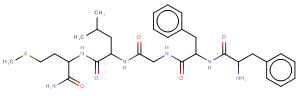
Substance P (7-11)
CAS No. 51165-05-0
Substance P (7-11)( —— )
Catalog No. M30419 CAS No. 51165-05-0
Substance P (7-11) is a C-terminal fragment of Substance P, which can cause an increase in the intracellular calcium concentration as measured by the fluorescent dye Fura-2. In addition, the C-terminal fragment of SP, SP-(7-11), increased PGE2 and collagenase production at concentrations greater than 1 mM.
Purity : >98% (HPLC)
 COA
Datasheet
HNMR
HPLC
MSDS
Handing Instructions
COA
Datasheet
HNMR
HPLC
MSDS
Handing Instructions
| Size | Price / USD | Stock | Quantity |
| 2MG | 37 | In Stock |


|
| 5MG | 61 | In Stock |
|
| 10MG | 107 | In Stock |
|
| 25MG | 179 | In Stock |
|
| 50MG | 263 | In Stock |
|
| 100MG | 363 | In Stock |
|
| 200MG | Get Quote | In Stock |
|
| 500MG | Get Quote | In Stock |
|
| 1G | Get Quote | In Stock |
|
Biological Information
-
Product NameSubstance P (7-11)
-
NoteResearch use only, not for human use.
-
Brief DescriptionSubstance P (7-11) is a C-terminal fragment of Substance P, which can cause an increase in the intracellular calcium concentration as measured by the fluorescent dye Fura-2. In addition, the C-terminal fragment of SP, SP-(7-11), increased PGE2 and collagenase production at concentrations greater than 1 mM.
-
DescriptionSubstance P (7-11) is a C-terminal fragment of Substance P, which can cause an increase in the intracellular calcium concentration as measured by the fluorescent dye Fura-2. In addition, the C-terminal fragment of SP, SP-(7-11), increased PGE2 and collagenase production at concentrations greater than 1 mM.(In Vitro):Substance P (7-11) increases PGE2 and collagenase production at concentrations greater than 1 μM. Substance P (7-11), but not intact SP, SP-(1-4), SP-(1-6), SP- (8-11) or SP-(9-1 1), nor the tachykinins NKA and NKB, causes an increase in the intracellular calcium concentration as measured by the fluorescent dye Fura-2. The maximal change in intracellular calcium induced by 10 μM Substance P (7-11) was 140±30 nM.
-
In VitroSubstance P (7-11) increases PGE2 and collagenase production at concentrations greater than 1 μM. Substance P (7-11), but not intact SP, SP-(1-4), SP-(1-6), SP- (8-11) or SP-(9-1 1), nor the tachykinins NKA and NKB, causes an increase in the intracellular calcium concentration as measured by the fluorescent dye Fura-2. The maximal change in intracellular calcium induced by 10 μM Substance P (7-11) was 140±30 nM.
-
In Vivo——
-
Synonyms——
-
PathwayOthers
-
TargetOther Targets
-
Recptor——
-
Research Area——
-
Indication——
Chemical Information
-
CAS Number51165-05-0
-
Formula Weight612.78
-
Molecular FormulaC31H44N6O5S
-
Purity>98% (HPLC)
-
SolubilityIn Vitro:?H2O : 1.96 mg/mL (3.20 mM)
-
SMILES——
-
Chemical NameSequence:Phe-Phe-Gly-Leu-Met-NH2
Shipping & Storage Information
-
Storage(-20℃)
-
ShippingWith Ice Pack
-
Stability≥ 2 years
Reference
Halliday DA, et al. The substance P fragment SP-(7-11) increases prostaglandin E2, intracellular Ca2+ and collagenase production in bovine articular chondrocytes. Biochem J. 1993 May 15;292 ( Pt 1):57-62.
molnova catalog



related products
-
CINPA1
CINPA1 is a selective inhibitor of constitutive androstane receptor (CAR) with an IC50 of 70 nM for CAR-mediated transcription. CINPA1 can be used in studies about CAR function.
-
Triplin
Triplin is a chelator of copper ion. Triplin affects the transport of copper ions from ATX1 to RAN1.
-
5,7,8-Trimethoxycoum...
5,7,8-Trimethoxycoumarin is a natural product of Viola, Violaceae. 5,7,8-Trimethoxycoumarin can be used as a reference standard.
