


 Cart
Cart
 sales@molnova.com


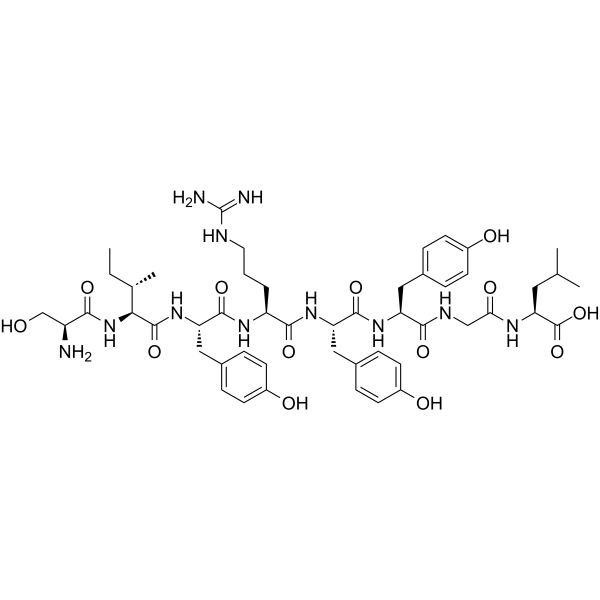
SIYRY
CAS No. 178561-37-0
SIYRY( —— )
Catalog No. M30247 CAS No. 178561-37-0
SIYRY is a Kb-restricted epitope peptide.
Purity : >98% (HPLC)
 COA
Datasheet
HNMR
HPLC
MSDS
Handing Instructions
COA
Datasheet
HNMR
HPLC
MSDS
Handing Instructions
| Size | Price / USD | Stock | Quantity |
| 100MG | Get Quote | Get Quote |


|
| 200MG | Get Quote | Get Quote |
|
| 500MG | Get Quote | Get Quote |
|
| 1G | Get Quote | Get Quote |
|
Biological Information
-
Product NameSIYRY
-
NoteResearch use only, not for human use.
-
Brief DescriptionSIYRY is a Kb-restricted epitope peptide.
-
DescriptionSIYRY is a Kb-restricted epitope peptide.
-
In Vitro——
-
In Vivo——
-
Synonyms——
-
PathwayOthers
-
TargetOther Targets
-
Recptor——
-
Research Area——
-
Indication——
Chemical Information
-
CAS Number178561-37-0
-
Formula Weight1034.16
-
Molecular FormulaC50H71N11O13
-
Purity>98% (HPLC)
-
Solubility——
-
SMILES——
-
Chemical NameSequence:{Ser}{Ile}{Tyr}{Arg}{Tyr}{Tyr}{Gly}{Leu}
Shipping & Storage Information
-
Storage(-20℃)
-
ShippingWith Ice Pack
-
Stability≥ 2 years
Reference
Sykulev Y, et al. Peptide antagonism and T cell receptor interactions with peptide-MHC complexes. Immunity. 1998 Oct;9(4):475-83.
molnova catalog



related products
-
Pomalidomide 4-PEG3-...
Pomalidomide 4'-PEG3-azide is a chemically synthesized E3 ligase ligand-linker conjugate that incorporates the cereblon ligand derived from Pomalidomide, along with a linker.
-
A-VI-5
A-VI-5
-
EMPA
EMPA is a selective, high-affinity and reversible antagonist of orexin OX2 receptor(human and rat OX2-HEK293 membranes with KD values of 1.1 and 1.4 nM respectively)EMPA displaces the EMPA binding from cell membranes containing human and rat OX2 receptors, with Ki values of 1.10±0.24 nM and 1.45±0.13 nM, respectively.?
