


 Cart
Cart
 sales@molnova.com


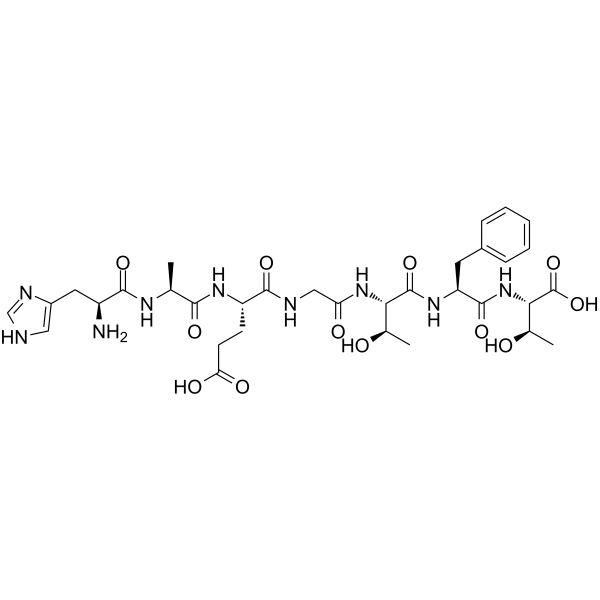
HAEGTFT
CAS No. 926018-95-3
HAEGTFT( —— )
Catalog No. M30118 CAS No. 926018-95-3
HAEGTFT is the first N-terminal 1-7 residues of GLP-1 peptide.
Purity : >98% (HPLC)
 COA
Datasheet
HNMR
HPLC
MSDS
Handing Instructions
COA
Datasheet
HNMR
HPLC
MSDS
Handing Instructions
| Size | Price / USD | Stock | Quantity |
| 5MG | 518 | Get Quote |


|
| 10MG | 794 | Get Quote |
|
| 100MG | Get Quote | Get Quote |
|
| 200MG | Get Quote | Get Quote |
|
| 500MG | Get Quote | Get Quote |
|
| 1G | Get Quote | Get Quote |
|
Biological Information
-
Product NameHAEGTFT
-
NoteResearch use only, not for human use.
-
Brief DescriptionHAEGTFT is the first N-terminal 1-7 residues of GLP-1 peptide.
-
DescriptionHAEGTFT is the first N-terminal 1-7 residues of GLP-1 peptide.
-
In Vitro——
-
In Vivo——
-
Synonyms——
-
PathwayGPCR/G Protein
-
TargetGlucagon Receptor
-
Recptor——
-
Research Area——
-
Indication——
Chemical Information
-
CAS Number926018-95-3
-
Formula Weight761.78
-
Molecular FormulaC33H47N9O12
-
Purity>98% (HPLC)
-
Solubility——
-
SMILES——
-
Chemical NameSequence:His-Ala-Glu-Gly-Thr-Phe-Thr
Shipping & Storage Information
-
Storage(-20℃)
-
ShippingWith Ice Pack
-
Stability≥ 2 years
Reference
molnova catalog



related products
-
Apraglutide
Apraglutide (FE 203799 is a synthetic 33-amino acid peptide and long-acting glp-2 analogue.
-
HAEGT
HAEGT is the first N-terminal 1-5 residues of GLP-1 peptide.
-
Bay 55-9837
Selective VPAC2 receptor agonist (EC50 values are 0.4, 100 and >1000 nM for VPAC2, VPAC1 and PAC1, respectively in a cAMP accumulation assay; IC50 values are 60, 8700 and >10000 nM for VPAC2, VPAC1 and PAC1, respectively in a competition binding assay). Stimulates glucose-dependent insulin secretion in isolated human pancreatic islets. Reduces HIV-1 viral replication and shows cooperative effects when given in conjunction with VPAC1 agonists.
