


 Cart
Cart
 sales@molnova.com


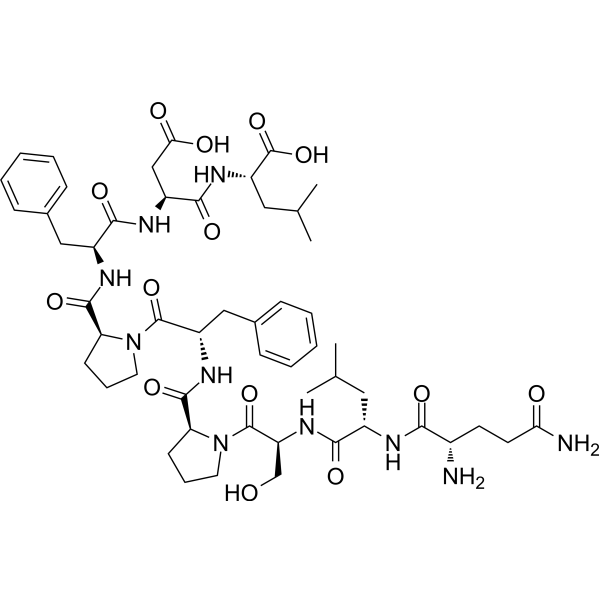
QL9
CAS No. 159646-83-0
QL9( —— )
Catalog No. M30096 CAS No. 159646-83-0
QL9 is derived from the enzyme 2-oxoglutarate dehydrogenase and belongs to the endogenous peptide repertoire of all H-2d APCs.
Purity : >98% (HPLC)
 COA
Datasheet
HNMR
HPLC
MSDS
Handing Instructions
COA
Datasheet
HNMR
HPLC
MSDS
Handing Instructions
| Size | Price / USD | Stock | Quantity |
| 5MG | 425 | Get Quote |


|
| 10MG | 721 | Get Quote |
|
| 100MG | Get Quote | Get Quote |
|
| 200MG | Get Quote | Get Quote |
|
| 500MG | Get Quote | Get Quote |
|
| 1G | Get Quote | Get Quote |
|
Biological Information
-
Product NameQL9
-
NoteResearch use only, not for human use.
-
Brief DescriptionQL9 is derived from the enzyme 2-oxoglutarate dehydrogenase and belongs to the endogenous peptide repertoire of all H-2d APCs.
-
DescriptionQL9 is derived from the enzyme 2-oxoglutarate dehydrogenase and belongs to the endogenous peptide repertoire of all H-2d APCs.(In Vitro):Mouse T cell clone 2C recognizes two different major histocompatibility (MHC) ligands, the self MHC Kb and the allogeneic MHC Ld. Two distinct peptides, SIY (SIYRYYGL) and QL9 (QLSPFPFDL), act as strong and specific agonists when bind to Kb and Ld, respectively. QL9 binding to MHC Ld is influenced by the majority of peptide side chains, distributed across the entire length of the peptide. Findings with both systems, but QL9-Ld in particular, suggest that many single-residue substitutions, introduced into peptides to improve their binding to MHC and thus their vaccine potential, could impair T cell reactivity due to their dual impact on TCR binding. T cell activation assays are performed to measure effects of peptide SIY and QL9 residues on T cell function.
-
In VitroMouse T cell clone 2C recognizes two different major histocompatibility (MHC) ligands, the self MHC Kb and the allogeneic MHC Ld. Two distinct peptides, SIY (SIYRYYGL) and QL9 (QLSPFPFDL), act as strong and specific agonists when bind to Kb and Ld, respectively. QL9 binding to MHC Ld is influenced by the majority of peptide side chains, distributed across the entire length of the peptide. Findings with both systems, but QL9-Ld in particular, suggest that many single-residue substitutions, introduced into peptides to improve their binding to MHC and thus their vaccine potential, could impair T cell reactivity due to their dual impact on TCR binding. T cell activation assays are performed to measure effects of peptide SIY and QL9 residues on T cell function.
-
In Vivo——
-
Synonyms——
-
PathwayOthers
-
TargetOther Targets
-
RecptorTCR
-
Research Area——
-
Indication——
Chemical Information
-
CAS Number159646-83-0
-
Formula Weight1063.21
-
Molecular FormulaC52H74N10O14
-
Purity>98% (HPLC)
-
SolubilityH2O : 33.33 mg/mL (31.35 mM; Need ultrasonic)
-
SMILES——
-
Chemical NameSequence:Gln-Leu-Ser-Pro-Phe-Pro-Phe-Asp-Leu
Shipping & Storage Information
-
Storage(-20℃)
-
ShippingWith Ice Pack
-
Stability≥ 2 years
Reference
Speir JA, et al. Structural basis of 2C TCR allorecognition of H-2Ld peptide complexes. Immunity. 1998 May;8(5):553-62.
molnova catalog



related products
-
Phyllanthusiin C
Phyllanthusiin C is a natural product of Terminalia, Combretaceae. Phyllanthusiin C can be used as a reference standard.
-
CTPI-2
CTPI-2 is an inhibitor of mitochondrial citrate carrier SLC25A1 with(KD : 3.5 μM).?CTPI-2 inhibits glycolysis, PPARγ, and its downstream target the glucose transporter GLUT4.?
-
AVP-13358
AVP-13358 is a CD23 antagonist (immunoglobulin ε-Fc receptor antagonist), an immunoglobulin E inhibitor.
