


 Cart
Cart
 sales@molnova.com


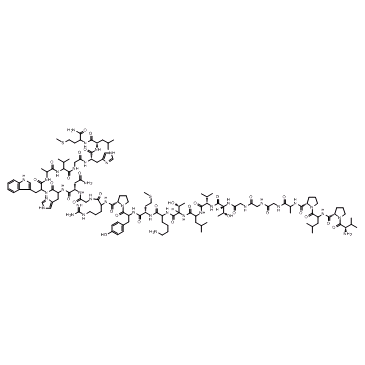
Gastrin-Releasing Peptide, human
CAS No. 93755-85-2
Gastrin-Releasing Peptide, human( —— )
Catalog No. M30024 CAS No. 93755-85-2
Gastrin-releasing peptide is a regulatory human peptide that elicits gastrin release and regulates gastric acid secretion and enteric motor function. The post-ganglionic fibers of the vagus nerve that innervate the G cells of the stomach release GRP, which stimulates the G cells to release gastrin.
Purity : >98% (HPLC)
 COA
Datasheet
HNMR
HPLC
MSDS
Handing Instructions
COA
Datasheet
HNMR
HPLC
MSDS
Handing Instructions
| Size | Price / USD | Stock | Quantity |
| 5MG | 462 | Get Quote |


|
| 100MG | Get Quote | Get Quote |
|
| 200MG | Get Quote | Get Quote |
|
| 500MG | Get Quote | Get Quote |
|
| 1G | Get Quote | Get Quote |
|
Biological Information
-
Product NameGastrin-Releasing Peptide, human
-
NoteResearch use only, not for human use.
-
Brief DescriptionGastrin-releasing peptide is a regulatory human peptide that elicits gastrin release and regulates gastric acid secretion and enteric motor function. The post-ganglionic fibers of the vagus nerve that innervate the G cells of the stomach release GRP, which stimulates the G cells to release gastrin.
-
DescriptionGastrin-releasing peptide is a regulatory human peptide that elicits gastrin release and regulates gastric acid secretion and enteric motor function. The post-ganglionic fibers of the vagus nerve that innervate the G cells of the stomach release GRP, which stimulates the G cells to release gastrin.(In Vitro):Gastrin-Releasing Peptide, human (GRP) belongs to the bombesin-like peptide family, and is not a classical hypothalamic-hypophyseal regulatory hormone since it plays only a perfunctory role in the mediation of pituitary hormone release. However, GRP/bombesin-like immunoreactivity is widely distributed in mammalian brain, especially the hypothalamus, GI tract and in human fetal lung.
-
In VitroGastrin-Releasing Peptide, human (GRP) belongs to the bombesin-like peptide family, and is not a classical hypothalamic-hypophyseal regulatory hormone since it plays only a perfunctory role in the mediation of pituitary hormone release. However, GRP/bombesin-like immunoreactivity is widely distributed in mammalian brain, especially the hypothalamus, GI tract and in human fetal lung.
-
In Vivo——
-
Synonyms——
-
PathwayOthers
-
TargetOther Targets
-
Recptor——
-
Research Area——
-
Indication——
Chemical Information
-
CAS Number93755-85-2
-
Formula Weight2859.38
-
Molecular FormulaC130H204N38O31S2
-
Purity>98% (HPLC)
-
SolubilityIn Vitro:?H2O : 100 mg/mL (34.97 mM)
-
SMILES——
-
Chemical NameSequence:Val-Pro-Leu-Pro-Ala-Gly-Gly-Gly-Thr-Val-Leu-Thr-Lys-Met-Tyr-Pro-Arg-Gly-Asn-His-Trp-Ala-Val-Gly-His-Leu-Met-NH2
Shipping & Storage Information
-
Storage(-20℃)
-
ShippingWith Ice Pack
-
Stability≥ 2 years
Reference
Dubovy SR, et al. Expression of hypothalamic neurohormones and their receptors in the human eye. Oncotarget. 2017 Jun 3.
molnova catalog



related products
-
Acacetin-7-O-beta-D-...
Acacetin-7-O-beta-D-galactopyranoside is a natural product found in Chrysanthemum indicum.
-
12-Dipalmitoyl-sn-gl...
12-Dipalmitoyl-sn-glycerol is an analog of the PKC-activating second messenger diacylglycerol (DAG). It weakly activates PKC.
-
Isobavachin
Isobavachin can facilitate mouse ES cells differentiating into neuronal cells.
