


 Cart
Cart
 sales@molnova.com


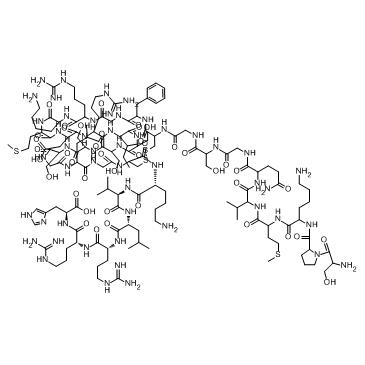
Nesiritide
CAS No. 124584-08-3
Nesiritide( Brain Natriuretic Peptide-32 human; BNP-32 )
Catalog No. M29907 CAS No. 124584-08-3
Nesiritide is the recombinant form of the 32 amino acid human B-type natriuretic peptide, which is normally produced by the ventricular myocardium. It is an agonist of natriuretic peptide receptors (NPRs), with Kd values of 7.3 and 13 pM for NPR-A and NPR-C, respectively.
Purity : >98% (HPLC)
 COA
Datasheet
HNMR
HPLC
MSDS
Handing Instructions
COA
Datasheet
HNMR
HPLC
MSDS
Handing Instructions
| Size | Price / USD | Stock | Quantity |
| 5MG | 761 | Get Quote |


|
| 10MG | 1158 | Get Quote |
|
| 100MG | Get Quote | Get Quote |
|
| 200MG | Get Quote | Get Quote |
|
| 500MG | Get Quote | Get Quote |
|
| 1G | Get Quote | Get Quote |
|
Biological Information
-
Product NameNesiritide
-
NoteResearch use only, not for human use.
-
Brief DescriptionNesiritide is the recombinant form of the 32 amino acid human B-type natriuretic peptide, which is normally produced by the ventricular myocardium. It is an agonist of natriuretic peptide receptors (NPRs), with Kd values of 7.3 and 13 pM for NPR-A and NPR-C, respectively.
-
DescriptionNesiritide is the recombinant form of the 32 amino acid human B-type natriuretic peptide, which is normally produced by the ventricular myocardium. It is an agonist of natriuretic peptide receptors (NPRs), with Kd values of 7.3 and 13 pM for NPR-A and NPR-C, respectively.(In Vitro):Nesiritide is an agonist of natriuretic peptide receptor (NPR), with Kd values of 7.3 and 13 pM for NPR-A and NPR-C, respectively. ProBNP1-108 stimulates guanylyl cyclase-A (GC-A) to near-maximum activities but is 13-fold less potent than Nesiritide (BNP1-32). ProBNP1-108 binds human GC-A 35-fold less tightly than Nesiritide. Neither proBNP1–108 nor Nesiritide activates GC-B. The natriuretic peptide clearance receptor binds proBNP1-108 3-fold less tightly than Nesiritide. The half time for degradation of proBNP1-108 by human kidney membranes is 2.7-fold longer than for Nesiritide, and the time required for complete degradation is 6-fold longer. Nesiritide and proBNP1-108 are best fitted by first- and second-order exponential decay models, respectively.
-
In VitroNesiritide (Brain Natriuretic Peptide-32 human) is an agonist of natriuretic peptide receptor (NPR), with Kd values of 7.3 and 13 pM for NPR-A and NPR-C, respectively. ProBNP1-108 stimulates guanylyl cyclase-A (GC-A) to near-maximum activities but is 13-fold less potent than Nesiritide (BNP1-32). ProBNP1-108 binds human GC-A 35-fold less tightly than Nesiritide. Neither proBNP1–108 nor Nesiritide activates GC-B. The natriuretic peptide clearance receptor binds proBNP1-108 3-fold less tightly than Nesiritide. The half time for degradation of proBNP1-108 by human kidney membranes is 2.7-fold longer than for Nesiritide, and the time required for complete degradation is 6-fold longer. Nesiritide and proBNP1-108 are best fitted by first- and second-order exponential decay models, respectively.
-
In Vivo——
-
SynonymsBrain Natriuretic Peptide-32 human; BNP-32
-
PathwayOthers
-
TargetOther Targets
-
RecptorKd: 7.3 Pm (NPR-A), 13 pM (NPR-C)
-
Research Area——
-
Indication——
Chemical Information
-
CAS Number124584-08-3
-
Formula Weight3464.04
-
Molecular FormulaC143H244N50O42S4
-
Purity>98% (HPLC)
-
SolubilityH2O : ≥ 40 mg/mL (11.55 mM)
-
SMILES——
-
Chemical NameSequence:Ser-Pro-Lys-Met-Val-Gln-Gly-Ser-Gly-Cys-Phe-Gly-Arg-Lys-Met-Asp-Arg-Ile-Ser-Ser-Ser-Ser-Gly-Leu-Gly-Cys-Lys-Val-Leu-Arg-Arg-His (Disulfide bridge: Cys10-Cys26)
Shipping & Storage Information
-
Storage(-20℃)
-
ShippingWith Ice Pack
-
Stability≥ 2 years
Reference
Koller KJ, et al. Molecular biology of the natriuretic peptides and their receptors. Circulation. 1992 Oct;86(4):1081-8.
molnova catalog



related products
-
Dabcyl acid
Dabcyl acid is the original dark fluorescence quencher.
-
Zearalenone
Zearalenone is a mycotoxin produced mainly by fungi belonging to the genus Fusarium in foods and feeds. Possess oestrogenic activity in pigs cattle and sheep with low acute toxicity. Causes precocious development of mammae and other estrogenic effects in young gilts.
-
Cecropin A (1-7)-Mel...
Cecropin A (1-7)-Melittin A (2-9) is an antimicrobial peptide with antimicrobial activity against a broad spectrum of Gram-positive and Gram-negative aerobic bacteria, as well as antimalarial activity, without the adverse hemolytic properties of bee venom peptides.
