


 Cart
Cart
 sales@molnova.com


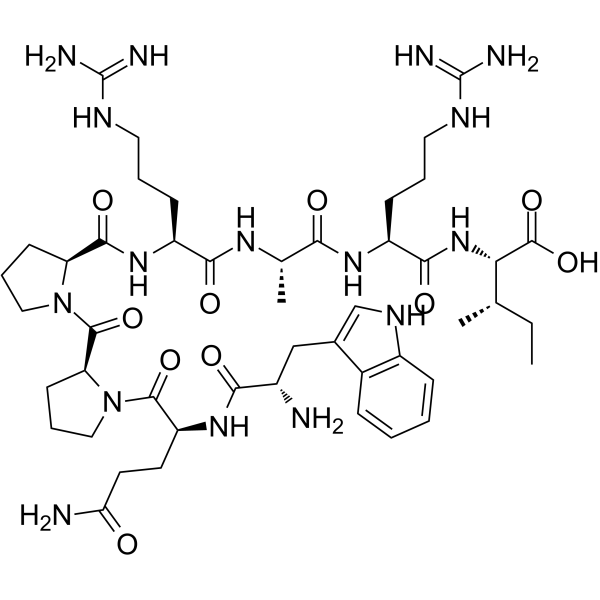
Fibronectin Adhesion-promoting Peptide
CAS No. 125720-21-0
Fibronectin Adhesion-promoting Peptide( Heparin Binding Peptide )
Catalog No. M29852 CAS No. 125720-21-0
Fibronectin Adhesion-promoting Peptide (Heparin Binding Peptide) is one of the heparin-binding amino acid sequences found in the carboxy-terminal heparin-binding domain of fibronectin.
Purity : >98% (HPLC)
 COA
Datasheet
HNMR
HPLC
MSDS
Handing Instructions
COA
Datasheet
HNMR
HPLC
MSDS
Handing Instructions
| Size | Price / USD | Stock | Quantity |
| 5MG | 211 | Get Quote |


|
| 10MG | 336 | Get Quote |
|
| 100MG | Get Quote | Get Quote |
|
| 200MG | Get Quote | Get Quote |
|
| 500MG | Get Quote | Get Quote |
|
| 1G | Get Quote | Get Quote |
|
Biological Information
-
Product NameFibronectin Adhesion-promoting Peptide
-
NoteResearch use only, not for human use.
-
Brief DescriptionFibronectin Adhesion-promoting Peptide (Heparin Binding Peptide) is one of the heparin-binding amino acid sequences found in the carboxy-terminal heparin-binding domain of fibronectin.
-
DescriptionFibronectin Adhesion-promoting Peptide (Heparin Binding Peptide) is one of the heparin-binding amino acid sequences found in the carboxy-terminal heparin-binding domain of fibronectin. (In Vitro):GRGDS and Fibronectin Adhesion-promoting Peptide (Heparin Binding Peptide: WQPPRARI) micropatterns increase the endothelialisation of prosthetic materials in vitro. Fibronectin Adhesion-promoting Peptide also enhances haptotactic cell migration. The anti-apoptotic effects of fibronectin require the presence of the WQPPRARI sequence, which may be due to synergistic survival signals mediated by this sequence and by the RGD motif. RDGS and Fibronectin Adhesion-promoting Peptide promote cell adhesion through different activation pathways that induce different forms of adhesion which can be highlighted through the analysis of focal and fibrillar contacts.
-
In VitroGRGDS and Fibronectin Adhesion-promoting Peptide (Heparin Binding Peptide: WQPPRARI) micropatterns increase the endothelialisation of prosthetic materials in vitro.Fibronectin Adhesion-promoting Peptide also enhances haptotactic cell migration. The anti-apoptotic effects of fibronectin require the presence of the WQPPRARI sequence, which may be due to synergistic survival signals mediated by this sequence and by the RGD motif.RDGS and Fibronectin Adhesion-promoting Peptide promote cell adhesion through different activation pathways that induce different forms of adhesion which can be highlighted through the analysis of focal and fibrillar contacts. They are for reference only.
-
In Vivo——
-
SynonymsHeparin Binding Peptide
-
PathwayOthers
-
TargetOther Targets
-
Recptor——
-
Research Area——
-
Indication——
Chemical Information
-
CAS Number125720-21-0
-
Formula Weight1023.19
-
Molecular FormulaC47H74N16O10
-
Purity>98% (HPLC)
-
SolubilityH2O : 2 mg/mL (1.95 mM; Need ultrasonic and warming)
-
SMILES——
-
Chemical NameSequence:Trp-Gln-Pro-Pro-Arg-Ala-Arg-Ile
Shipping & Storage Information
-
Storage(-20℃)
-
ShippingWith Ice Pack
-
Stability≥ 2 years
Reference
Hoesli CA, et al. A fluorophore-tagged RGD peptide to control endothelial cell adhesion to micropatterned surfaces. Biomaterials. 2014 Jan;35(3):879-90.
molnova catalog



related products
-
Methyl acetoacetate
Methylacetoacetic acid has been identified in the urine of patients with an inherited deficiency of propionyl-CoA carboxylase and after isoleucine loading in the diagnosis of 2-methylacetoacetyl-CoA thiolase deficiency.
-
4-O-beta-Glucopyrano...
4-O-beta-Glucopyranosyl-cis-coumaric acid is a natural product.
-
N-Methylisatoic anhy...
N-Methylisatoic anhydride is a 2'-OH selective acylation agent of RNAs.
