


 Cart
Cart
 sales@molnova.com


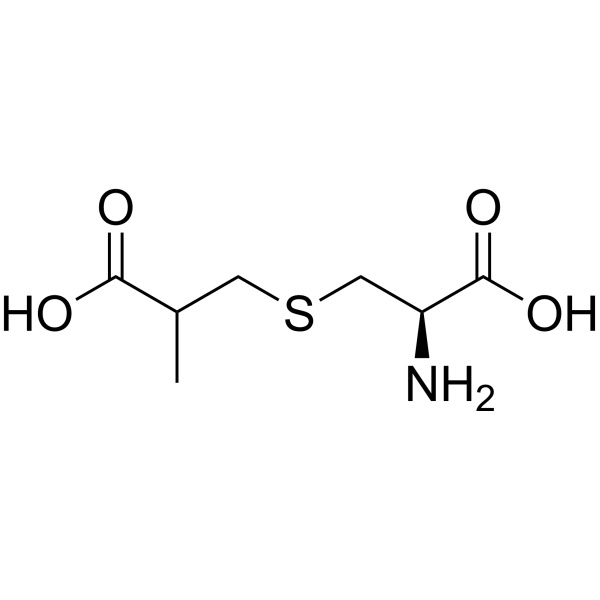
S-(2-Carboxypropyl)cysteine
CAS No. 6852-42-2
S-(2-Carboxypropyl)cysteine( S-(2-carboxypropyl)-L-cysteine )
Catalog No. M29485 CAS No. 6852-42-2
S-(2-Carboxypropyl)cysteine is a urinary metabolite of S-(2-Carboxypropyl)glutathione.
Purity : >98% (HPLC)
 COA
Datasheet
HNMR
HPLC
MSDS
Handing Instructions
COA
Datasheet
HNMR
HPLC
MSDS
Handing Instructions
| Size | Price / USD | Stock | Quantity |
| 1 mL x 10 mM in DMSO | 30 | In Stock |


|
| 10MG | 41 | In Stock |
|
| 25MG | 72 | In Stock |
|
| 50MG | 110 | In Stock |
|
| 100MG | 176 | In Stock |
|
| 200MG | 259 | In Stock |
|
| 500MG | 442 | In Stock |
|
| 1G | Get Quote | In Stock |
|
Biological Information
-
Product NameS-(2-Carboxypropyl)cysteine
-
NoteResearch use only, not for human use.
-
Brief DescriptionS-(2-Carboxypropyl)cysteine is a urinary metabolite of S-(2-Carboxypropyl)glutathione.
-
DescriptionS-(2-Carboxypropyl)cysteine is a urinary metabolite of S-(2-Carboxypropyl)glutathione.
-
In Vitro——
-
In Vivo——
-
SynonymsS-(2-carboxypropyl)-L-cysteine
-
PathwayProteasome/Ubiquitin
-
TargetEndogenous Metabolite
-
RecptorEndogenous Metabolite
-
Research Area——
-
Indication——
Chemical Information
-
CAS Number6852-42-2
-
Formula Weight207.25
-
Molecular FormulaC7H13NO4S
-
Purity>98% (HPLC)
-
SolubilityIn Vitro:?DMSO : 25 mg/mL (120.63 mM)
-
SMILESN[C@@H](CSCC(C(O)=O)C)C(O)=O
-
Chemical Name——
Shipping & Storage Information
-
Storage(-20℃)
-
ShippingWith Ice Pack
-
Stability≥ 2 years
Reference
molnova catalog



related products
-
Ebaresdax hydrochlor...
Ebaresdax hydrochloride has analgesic activity and is used in the study of painful diabetic neuropathy caused by type I or type II diabetes.
-
Docosapentaenoic aci...
Docosapentaenoic acid 22n-3 is present in the cell membranes of all animals and is a component of phospholipids.
-
γ-Cyclodextrin
Gamma cyclodextrin is a cycloamylose composed of eight alpha-(1->4) linked D-glucopyranose units found in some foods.
