


 Cart
Cart
 sales@molnova.com


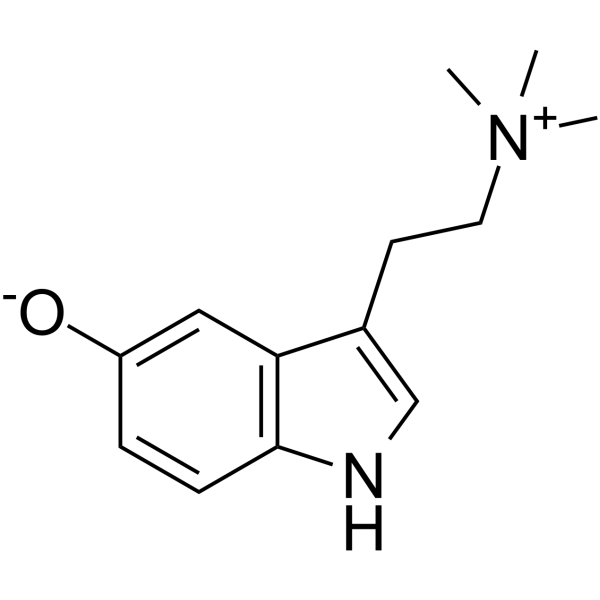
Bufotenidine
CAS No. 487-91-2
Bufotenidine( —— )
Catalog No. M29450 CAS No. 487-91-2
Bufotenidine is a neural tryptaminic receptor blocking agent blocks the effects of both 5-HT and morphine on intestinal motility.
Purity : >98% (HPLC)
 COA
Datasheet
HNMR
HPLC
MSDS
Handing Instructions
COA
Datasheet
HNMR
HPLC
MSDS
Handing Instructions
| Size | Price / USD | Stock | Quantity |
| 5MG | 574 | Get Quote |


|
| 100MG | Get Quote | Get Quote |
|
| 200MG | Get Quote | Get Quote |
|
| 500MG | Get Quote | Get Quote |
|
| 1G | Get Quote | Get Quote |
|
Biological Information
-
Product NameBufotenidine
-
NoteResearch use only, not for human use.
-
Brief DescriptionBufotenidine is a neural tryptaminic receptor blocking agent blocks the effects of both 5-HT and morphine on intestinal motility.
-
DescriptionBufotenidine is a neural tryptaminic receptor blocking agent blocks the effects of both 5-HT and morphine on intestinal motility.
-
In Vitro——
-
In Vivo——
-
Synonyms——
-
PathwayOthers
-
TargetOther Targets
-
Recptor——
-
Research Area——
-
Indication——
Chemical Information
-
CAS Number487-91-2
-
Formula Weight218.29
-
Molecular FormulaC13H18N2O
-
Purity>98% (HPLC)
-
Solubility——
-
SMILESC[N+](C)(C)CCC1=CNC2=C1C=C([O-])C=C2
-
Chemical Name——
Shipping & Storage Information
-
Storage(-20℃)
-
ShippingWith Ice Pack
-
Stability≥ 2 years
Reference
molnova catalog



related products
-
Fendosal
Fendosal is a non-steroidal anti-inflammatory agent. It is 6.9 to 9.5 times more active than aspirin in the prophylactic and therapeutic adjuvant-induced polyarthritis models of chronic inflammation.
-
Fragransin B1
Fragransin B1 has antiprotozoal activity and is cytotoxic to rat myoblast L6 cells.
-
N-Formyl-Met-Ala-Ser
N-Formyl-Met-Ala-Ser is a peptide, binds to formyl peptide receptors on neutrophils.N-Formyl-Met-Ala-Ser Peptide (fMet-Ala-Ser) binds to formyl peptide receptors on neutrophils. N-Formylmethionine-containing peptides including the most potent and known member, N-formyl-Met-Leu-Phe (FMLP or fMet-Leu-Phe) stimulate human neutrophils by a receptor-dependent mechanism.
