


 Cart
Cart
 sales@molnova.com


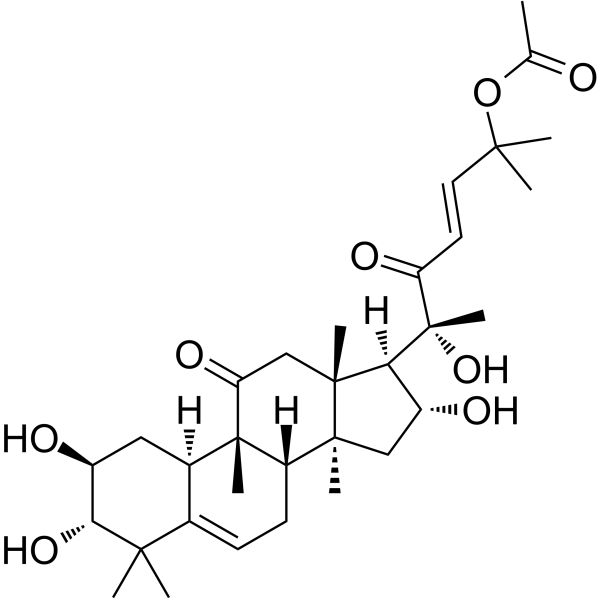
Cucurbitacin Q1
CAS No. 99530-82-2
Cucurbitacin Q1( Cucurbitacin F-25-acetate )
Catalog No. M29247 CAS No. 99530-82-2
Cucurbitacin Q1 is identified as the fruit of Cucumis prophetarum and has been shown to be the pure trans component of cucurbitacin Q.
Purity : >98% (HPLC)
 COA
Datasheet
HNMR
HPLC
MSDS
Handing Instructions
COA
Datasheet
HNMR
HPLC
MSDS
Handing Instructions
| Size | Price / USD | Stock | Quantity |
| 1 mL x 10 mM in DMSO | 242 | In Stock |


|
| 5MG | 187 | In Stock |
|
| 10MG | 297 | In Stock |
|
| 25MG | 534 | In Stock |
|
| 100MG | Get Quote | In Stock |
|
| 200MG | Get Quote | In Stock |
|
| 500MG | Get Quote | In Stock |
|
| 1G | Get Quote | In Stock |
|
Biological Information
-
Product NameCucurbitacin Q1
-
NoteResearch use only, not for human use.
-
Brief DescriptionCucurbitacin Q1 is identified as the fruit of Cucumis prophetarum and has been shown to be the pure trans component of cucurbitacin Q.
-
DescriptionCucurbitacin Q1 is identified as the fruit of Cucumis prophetarum and has been shown to be the pure trans component of cucurbitacin Q.
-
In Vitro——
-
In Vivo——
-
SynonymsCucurbitacin F-25-acetate
-
PathwayOthers
-
TargetOther Targets
-
Recptor——
-
Research Area——
-
Indication——
Chemical Information
-
CAS Number99530-82-2
-
Formula Weight560.728
-
Molecular FormulaC32H48O8
-
Purity>98% (HPLC)
-
Solubility——
-
SMILES[H][C@@]12C[C@H](O)[C@@H](O)C(C)(C)C1=CC[C@@]1([H])[C@]3(C)C[C@@H](O)[C@H]([C@@](C)(O)C(=O)\C=C\C(C)(C)OC(C)=O)[C@@]3(C)CC(=O)[C@@]21C
-
Chemical Name——
Shipping & Storage Information
-
Storage(-20℃)
-
ShippingWith Ice Pack
-
Stability≥ 2 years
Reference
molnova catalog



related products
-
PalMitoyl Tripeptide...
Palmitoyl tripeptide-1 has effects on the synthesis of collagen, fibronectin and hyaluronic acid in human skin fibroblasts, and can be used in the preparation of anti-aging cosmetics.
-
Cyclo(Pro-Gly)
Cyclo(Pro-Gly) is an active metabolite of piracetam-N-phenylacetyl-L-prolylglycine (GWS-111), it shows a greater resistance to an enzymatic effect than natural neuropeptides. Cyclo-(Gly-Pro) shows cytotoxicity at the concentration of 10 umol/L, it inhibits the growth of Bacillus subtilis with the minimal inhibitory concentration (MIC) value of 0.8, 0.8 g/L.
-
PXS-5120A
PXS-5120A is an irreversible fluoroallylamine Lysyl Oxidase-like 2/3 (LOXL2/3) inhibitor with anti-fibrotic activity.
