


 Cart
Cart
 sales@molnova.com


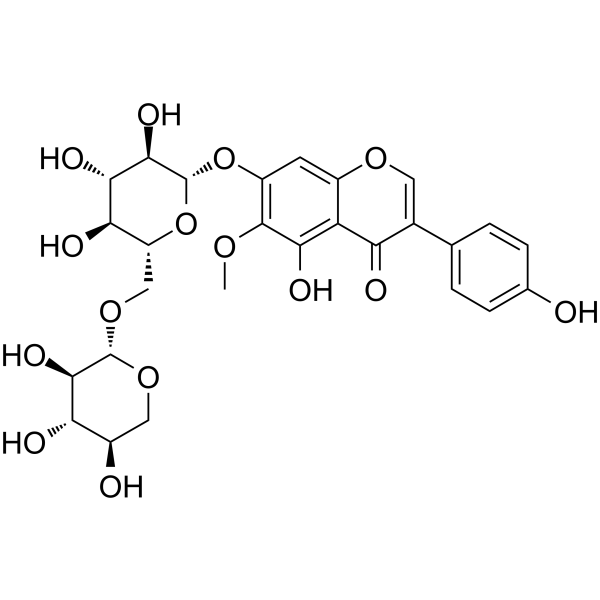
Tectorigenin 7-?O-?Xylosyl Glucoside
CAS No. 231288-19-0
Tectorigenin 7-?O-?Xylosyl Glucoside( Tectorigenin 7-O-xylosylglucoside )
Catalog No. M29234 CAS No. 231288-19-0
Tectorigenin 7-O-xylosylglucoside is a natural product.
Purity : >98% (HPLC)
 COA
Datasheet
HNMR
HPLC
MSDS
Handing Instructions
COA
Datasheet
HNMR
HPLC
MSDS
Handing Instructions
| Size | Price / USD | Stock | Quantity |
| 1 mL x 10 mM in DMSO | 372 | In Stock |


|
| 5MG | 244 | In Stock |
|
| 10MG | 361 | In Stock |
|
| 25MG | 606 | In Stock |
|
| 50MG | 828 | In Stock |
|
| 100MG | Get Quote | In Stock |
|
| 200MG | Get Quote | In Stock |
|
| 500MG | Get Quote | In Stock |
|
| 1G | Get Quote | In Stock |
|
Biological Information
-
Product NameTectorigenin 7-?O-?Xylosyl Glucoside
-
NoteResearch use only, not for human use.
-
Brief DescriptionTectorigenin 7-O-xylosylglucoside is a natural product.
-
DescriptionTectorigenin 7-O-xylosylglucoside is a natural product.
-
In Vitro——
-
In Vivo——
-
SynonymsTectorigenin 7-O-xylosylglucoside
-
PathwayOthers
-
TargetOther Targets
-
Recptor——
-
Research Area——
-
Indication——
Chemical Information
-
CAS Number231288-19-0
-
Formula Weight594.522
-
Molecular FormulaC27H30O15
-
Purity>98% (HPLC)
-
Solubility——
-
SMILESCOc1c(O[C@@H]2O[C@H](CO[C@@H]3OC[C@@H](O)[C@H](O)[C@H]3O)[C@@H](O)[C@H](O)[C@H]2O)cc2occ(-c3ccc(O)cc3)c(=O)c2c1O
-
Chemical Name——
Shipping & Storage Information
-
Storage(-20℃)
-
ShippingWith Ice Pack
-
Stability≥ 2 years
Reference
molnova catalog



related products
-
A2ti-2
A2ti-2 is a low affinity and selective inhibitor of the membrane-bound protein A2/S100A10 heterotetramer (A2t) (IC50 : 230 μM).
-
TC-AQP1-1
TC-AQP1-1 is a blocker of the aquaporin 1 channel identified by virtual screening and inhibits water flux through hAQP1 in Xenopus laevis oocyte swelling assays at low micromolar concentrations.
-
PALDA
PALDA (N-Palmitoyl dopamine) is a fatty acid dopamine found in the mammalian brain that is inactive against TRPV1 and inactivates at TRPV(1)R. It is used in the study of duodenal ulcers.
