


 Cart
Cart
 sales@molnova.com


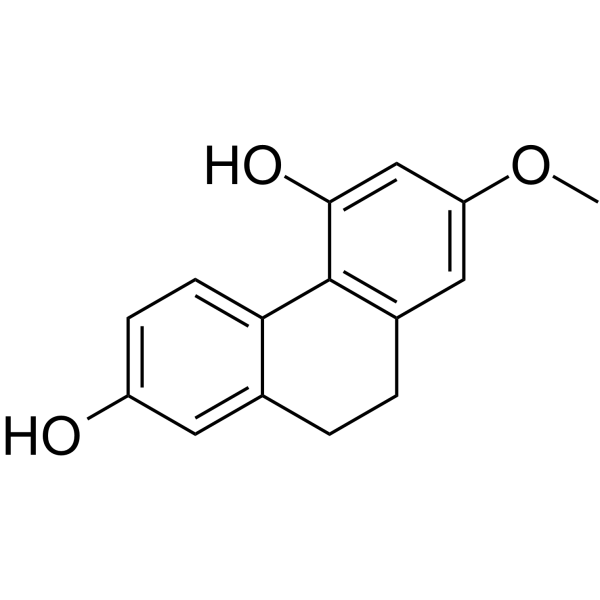
Lusianthridin
CAS No. 87530-30-1
Lusianthridin( —— )
Catalog No. M29188 CAS No. 87530-30-1
Lusianthridin is a natural product from Dendrobium venustum. Lusianthridin exhibits anti-migratory property at nontoxic concentrations.
Purity : >98% (HPLC)
 COA
Datasheet
HNMR
HPLC
MSDS
Handing Instructions
COA
Datasheet
HNMR
HPLC
MSDS
Handing Instructions
| Size | Price / USD | Stock | Quantity |
| 1 mL x 10 mM in DMSO | 523 | In Stock |


|
| 5MG | 513 | In Stock |
|
| 10MG | 740 | In Stock |
|
| 25MG | 1121 | In Stock |
|
| 50MG | 1507 | In Stock |
|
| 100MG | Get Quote | In Stock |
|
| 200MG | Get Quote | In Stock |
|
| 500MG | Get Quote | In Stock |
|
| 1G | Get Quote | In Stock |
|
Biological Information
-
Product NameLusianthridin
-
NoteResearch use only, not for human use.
-
Brief DescriptionLusianthridin is a natural product from Dendrobium venustum. Lusianthridin exhibits anti-migratory property at nontoxic concentrations.
-
DescriptionLusianthridin is a natural product from Dendrobium venustum. Lusianthridin exhibits anti-migratory property at nontoxic concentrations. Lusianthridin enhances c-Myc degradation through the inhibition of Src-STAT3 signaling.(In Vitro):Lusianthridin showed appreciable cytotoxicity against human lung cancer cell lines with IC50 values of 65.0 μg/mL. Lusianthridin (0-100 μM) inhibited cell viability at concentrations greater than 50 μM in both H460 and H292 cells. Lusianthridin significantly reduced the CSC populations in both H460 and H292 cells of the CSC spheres, with a significant decrease in the size of the H460 CSC spheres by approximately 10%, 63%, and 77% at day 3 at concentrations of 5, 10, and 20 μM, respectively.
-
In VitroLusianthridin (0-100 μM) inhibits cell viability at concentrations greater than 50 μM in both H460 and H292 cells.Lusianthridin significantly reduces the CSC populations in both H460 and H292 cells of the CSC spheres, with a significant decrease in the size of the H460 CSC spheres by approximately 10%, 63%, and 77% at day 3 at concentration 5, 10, and 20 μM Lusianthridin, respectively. Cell Viability Assay Cell Line:The human non-small cell lung cancer cell lines, NCI-H460, and NCI-H292 cells.0-100 μM.Concentration:0-100 μM.Incubation Time:24 h.Result:Caused a significant reduction in terms of cell viability at concentrations greater than 50 μM in both H460 and H292 cells.
-
In Vivo——
-
Synonyms——
-
PathwayOthers
-
TargetOther Targets
-
Recptor——
-
Research Area——
-
Indication——
Chemical Information
-
CAS Number87530-30-1
-
Formula Weight242.274
-
Molecular FormulaC15H14O3
-
Purity>98% (HPLC)
-
Solubility——
-
SMILESCOc1cc(O)c-2c(CCc3cc(O)ccc-23)c1
-
Chemical Name——
Shipping & Storage Information
-
Storage(-20℃)
-
ShippingWith Ice Pack
-
Stability≥ 2 years
Reference
molnova catalog



related products
-
TAS-102
TAS-102 is an investigational drug candidate for metastatic colorectal Y. It contains trifluridine (TFT) and Tipiracil hydrochloride (TTP) in a molar ratio of 2:1.
-
Nurulimab
Nurulimab (BCD-145) is an anti-cytotoxic T-lymphocyte antigen 4 (CTLA-4) human monoclonal antibody with anti-cancer activity for the study of skin and musculoskeletal diseases.
-
(15alpha,20Z)-15-hyd...
15a-Hydroxy-3,11,23-trioxo-lanost-8,20-dien-26-oic acid is a Lanostane triterpenoid compound with the ability to inhibit NO production in LPS-induced microglia.
