


 Cart
Cart
 sales@molnova.com


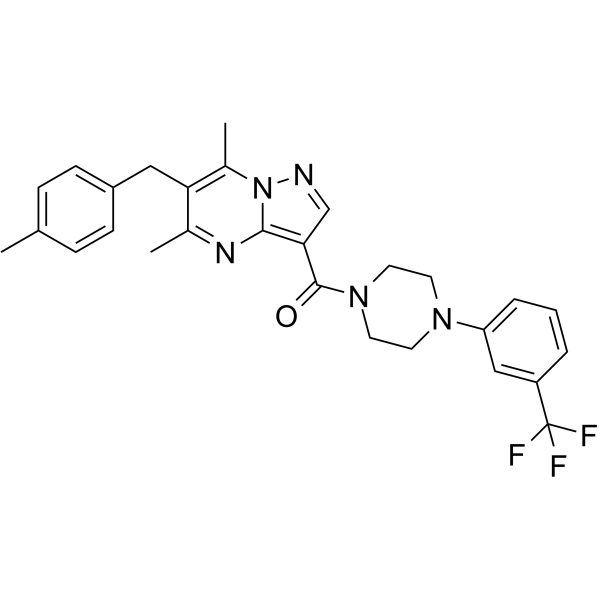
RUVBL1/2 ATPase-IN-1
CAS No. 423128-55-6
RUVBL1/2 ATPase-IN-1( —— )
Catalog No. M28950 CAS No. 423128-55-6
RUVBL1/2 ATPase-IN-1 is an effective RUVBL1/2 ATPase inhibitor with IC50 values of 6.0 and 7.7 μM, respectively. RUVBL1/2 ATPase-IN-1 can be used in cancer disease studies.
Purity : >98% (HPLC)
 COA
Datasheet
HNMR
HPLC
MSDS
Handing Instructions
COA
Datasheet
HNMR
HPLC
MSDS
Handing Instructions
| Size | Price / USD | Stock | Quantity |
| 5MG | 471 | In Stock |


|
| 10MG | 755 | In Stock |
|
| 25MG | 1359 | In Stock |
|
| 50MG | 1823 | In Stock |
|
| 100MG | 2585 | In Stock |
|
| 200MG | Get Quote | In Stock |
|
| 500MG | Get Quote | In Stock |
|
| 1G | Get Quote | In Stock |
|
Biological Information
-
Product NameRUVBL1/2 ATPase-IN-1
-
NoteResearch use only, not for human use.
-
Brief DescriptionRUVBL1/2 ATPase-IN-1 is an effective RUVBL1/2 ATPase inhibitor with IC50 values of 6.0 and 7.7 μM, respectively. RUVBL1/2 ATPase-IN-1 can be used in cancer disease studies.
-
DescriptionRUVBL1/2 ATPase-IN-1 is an effective RUVBL1/2 ATPase inhibitor with IC50 values of 6.0 and 7.7 μM, respectively. RUVBL1/2 ATPase-IN-1 can be used in cancer disease studies.
-
In Vitro——
-
In Vivo——
-
Synonyms——
-
PathwayOthers
-
TargetOther Targets
-
RecptorFree Fatty Acid Receptor
-
Research Area——
-
Indication——
Chemical Information
-
CAS Number423128-55-6
-
Formula Weight507.5
-
Molecular FormulaC28H28F3N5O
-
Purity>98% (HPLC)
-
SolubilityIn Vitro:?DMSO : 10 mg/mL (19.70 mM)
-
SMILESO=C(C1=C2N=C(C)C(CC3=CC=C(C)C=C3)=C(C)N2N=C1)N4CCN(C5=CC=CC(C(F)(F)F)=C5)CC4
-
Chemical Name——
Shipping & Storage Information
-
Storage(-20℃)
-
ShippingWith Ice Pack
-
Stability≥ 2 years
Reference
1.Panse M, et al. Activation of extracellular signal-regulated protein kinases 1 and 2 (ERK1/2) by free fatty acid receptor 1 (FFAR1/GPR40) protects from palmitate-induced beta cell death, but plays no role in insulin secretion. Cell Physiol Biochem. 2015;35(4):1537-45.
molnova catalog



related products
-
Ganodermanontriol
Ganodermanontriol, a sterol derived from Ganoderma lucidum, showcases hepatoprotective activity and possesses anti-inflammatory properties in tert-butyl hydroperoxide (t-BHP)-damaged hepatic cells through the upregulation of HO-1 expression.
-
Methyl isovanillate
Methyl isovanillate is a natural product from Vitex agnus-castus.
-
Tiagabine hydrochlor...
Tiagabine Hydrochloride is the hydrochloride salt form of tiagabine, a nipecotic acid derivative with anticonvulsant property.
