


 Cart
Cart
 sales@molnova.com


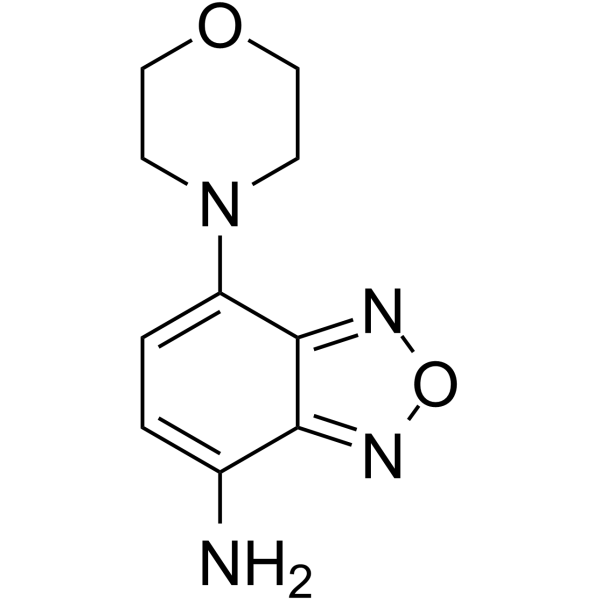
δ-secretase inhibitor 11
CAS No. 842964-18-5
δ-secretase inhibitor 11( —— )
Catalog No. M28852 CAS No. 842964-18-5
δ-secretase inhibitor 11 is an inhibitor of δ-secretase and can be used as a lead compound for translational development of AD treatment.
Purity : >98% (HPLC)
 COA
Datasheet
HNMR
HPLC
MSDS
Handing Instructions
COA
Datasheet
HNMR
HPLC
MSDS
Handing Instructions
| Size | Price / USD | Stock | Quantity |
| 1 mL x 10 mM in DMSO | 37 | In Stock |


|
| 5MG | 29 | In Stock |
|
| 10MG | 41 | In Stock |
|
| 25MG | 92 | In Stock |
|
| 50MG | 155 | In Stock |
|
| 100MG | 232 | In Stock |
|
| 200MG | Get Quote | In Stock |
|
| 500MG | Get Quote | In Stock |
|
| 1G | Get Quote | In Stock |
|
Biological Information
-
Product Nameδ-secretase inhibitor 11
-
NoteResearch use only, not for human use.
-
Brief Descriptionδ-secretase inhibitor 11 is an inhibitor of δ-secretase and can be used as a lead compound for translational development of AD treatment.
-
Descriptionδ-secretase inhibitor 11 is an inhibitor of δ-secretase and can be used as a lead compound for translational development of AD treatment. (In Vitro):The inhibitory effect of δ-secretase inhibitor 11 on AEP activity in vitro was tested and the dose-response relationship revealed that the δ-secretase inhibitor 11 had an IC50 value of 0.15 ± 0.09 μM . (In Vivo):It was found that oral administration of δ-secretase inhibitor 11 (10 mg/kg) significantly suppressed brain AEP activity compared to the vehicle treatment. The concentrations of Aβ1–40 and Aβ1–42 in brain lysates of SAMP8 mice were significantly reduced due to AEP inhibition by δ-secretase inhibitor 11.
-
In Vitro——
-
In VivoAnimal Model:Tau P301S transgenic mice (n=4 mice per group)Dosage:10 mg/kg Administration:Orally, once daily for 3 months Result:Significantly inhibited the activity of δ-secretase in both wild-type and tau P301S mice brain, increased PP2A activity, and attenuated the truncation and phosphorylation of tau in tau P301S mice. Ameliorated synaptic loss and restored synaptic dysfunction in tau P301S mice.Animal Model:5XFAD mice Dosage:2, 5 or 10?mg?kg Administration:Orally, once daily for 1.5 and 3 months Result:Attenuated the β-secretase-mediated processing of APP, significantly decreased the concentrations of Aβ 1-40 and Aβ 1-42 in the brain lysates, and attenuated Aβ deposition in a time- and dose-dependent manner.
-
Synonyms——
-
PathwayMembrane Transporter/Ion Channel
-
TargetBeta Amyloid
-
RecptorCOX-2
-
Research Area——
-
Indication——
Chemical Information
-
CAS Number842964-18-5
-
Formula Weight220.232
-
Molecular FormulaC10H12N4O2
-
Purity>98% (HPLC)
-
SolubilityIn Vitro:?DMSO : 125 mg/mL (567.59 mM)
-
SMILESNc1ccc(N2CCOCC2)c2nonc12
-
Chemical Name——
Shipping & Storage Information
-
Storage(-20℃)
-
ShippingWith Ice Pack
-
Stability≥ 2 years
Reference
1.Reddy MV, et al. Design, synthesis, and biological evaluation of 1-(4-sulfamylphenyl)-3-trifluoromethyl-5-indolyl pyrazolines as cyclooxygenase-2 (COX-2) and lipoxygenase (LOX) inhibitors. Bioorg Med Chem. 2008 Apr 1;16(7):3907-16.
molnova catalog



related products
-
Lecanemab
Lecanemab (BAN-2401) is an IgG1 monoclonal antibody targeting soluble aggregated β-amyloid (Abeta) with activity against oligomers, protofibrils, and insoluble protofibrils, and may be useful in the study of Alzheimer's disease (AD)-induced mild cognitive impairment and mild AD dementia.
-
Amyloid β-peptide (1...
Rat form of the beta-Amyloid (1-40) peptide.
-
β-Amyloid 1-34
This is a fragment of beta-amyloid peptide. It has amino acids 1 through 34.
