


 Cart
Cart
 sales@molnova.com


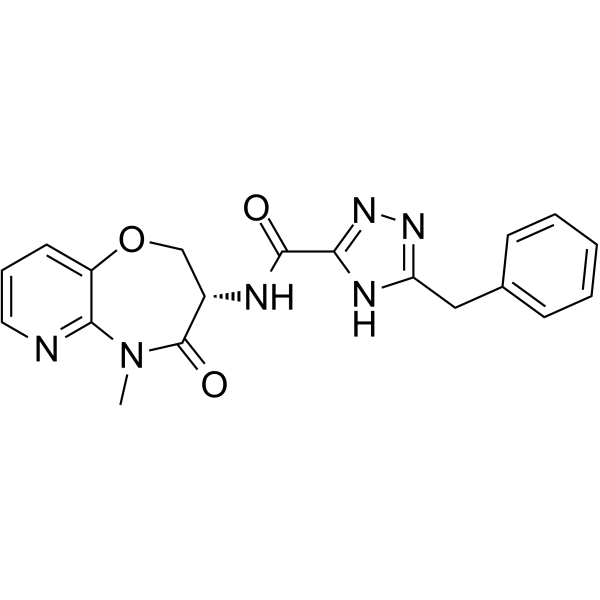
Eclitasertib
CAS No. 2125450-76-0
Eclitasertib( DNL-758 | SAR-443122 )
Catalog No. M28842 CAS No. 2125450-76-0
Eclitasertib is a potent inhibitor of receptor-interacting protein kinase 1 (RIPK1, IC50 of <1 μΜ).
Purity : >98% (HPLC)
 COA
Datasheet
HNMR
HPLC
MSDS
Handing Instructions
COA
Datasheet
HNMR
HPLC
MSDS
Handing Instructions
| Size | Price / USD | Stock | Quantity |
| 1 mL x 10 mM in DMSO | 250 | In Stock |


|
| 2MG | 145 | In Stock |
|
| 5MG | 227 | In Stock |
|
| 10MG | 359 | In Stock |
|
| 25MG | 653 | In Stock |
|
| 50MG | 886 | In Stock |
|
| 100MG | 1265 | In Stock |
|
| 200MG | Get Quote | In Stock |
|
| 500MG | Get Quote | In Stock |
|
| 1G | Get Quote | In Stock |
|
Biological Information
-
Product NameEclitasertib
-
NoteResearch use only, not for human use.
-
Brief DescriptionEclitasertib is a potent inhibitor of receptor-interacting protein kinase 1 (RIPK1, IC50 of <1 μΜ).
-
DescriptionEclitasertib is a potent inhibitor of receptor-interacting protein kinase 1 (RIPK1, IC50 of <1 μΜ).
-
In Vitro——
-
In Vivo——
-
SynonymsDNL-758 | SAR-443122
-
PathwayApoptosis
-
TargetRIP kinase
-
RecptorGLUT
-
Research Area——
-
Indication——
Chemical Information
-
CAS Number2125450-76-0
-
Formula Weight378.38
-
Molecular FormulaC19H18N6O3
-
Purity>98% (HPLC)
-
SolubilityIn Vitro:?DMSO : 125 mg/mL (330.36 mM)
-
SMILESCN(c1ncccc1OC[C@@H]1NC(c2nc(Cc3ccccc3)n[nH]2)=O)C1=O
-
Chemical Name——
Shipping & Storage Information
-
Storage(-20℃)
-
ShippingWith Ice Pack
-
Stability≥ 2 years
Reference
1.Liu KG, et al. Discovery and Optimization of Glucose Uptake Inhibitors. J Med Chem. 2020;63(10):5201-5211.
molnova catalog



related products
-
Sibiriline
A specific competitive RIPK1 inhibitor with IC50 of 1.03 uM, 100-fold less potent for RIPK3.
-
CSLP37
CSLP37 (RIPK2 inhibitor CSLP37) is a novel potent, ATP pocket-binding RIPK2 inhibitor with IC50 of 16.3 nM in ADPGlo assay.
-
Cpd27
Cpd27 (TIE-2/VEGFR-2 kinase-IN-2) is a TIE-2 and VEGFR-2 inhibitor that inhibits RIPK1 and protects RGCs from TNF-stimulated cell death and can be used to study glaucoma.
