


 Cart
Cart
 sales@molnova.com


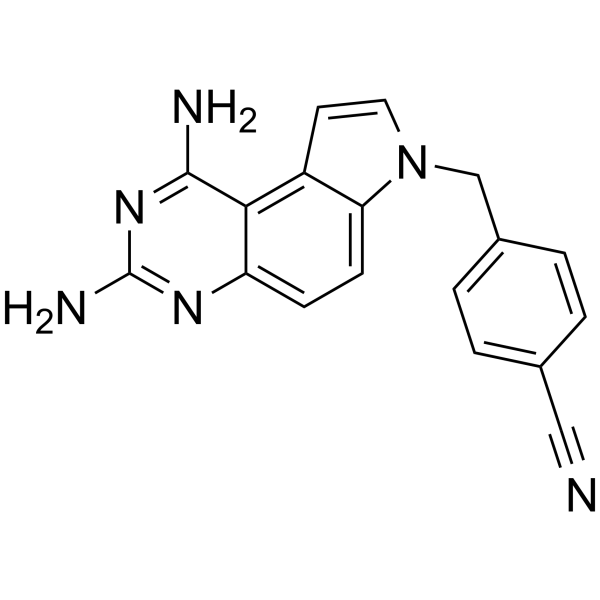
Antibacterial agent 27?
CAS No. 65795-51-9
Antibacterial agent 27?( 4-[(1,3-Diaminopyrrolo[3,2-f]quinazolin-7-yl)methyl]benzonitrile )
Catalog No. M28801 CAS No. 65795-51-9
Antibacterial agent 27 has potent anti-Candida activity.
Purity : >98% (HPLC)
 COA
Datasheet
HNMR
HPLC
MSDS
Handing Instructions
COA
Datasheet
HNMR
HPLC
MSDS
Handing Instructions
| Size | Price / USD | Stock | Quantity |
| 1 mL x 10 mM in DMSO | 92 | In Stock |


|
| 5MG | 84 | In Stock |
|
| 10MG | 136 | In Stock |
|
| 25MG | 255 | In Stock |
|
| 50MG | 373 | In Stock |
|
| 100MG | 554 | In Stock |
|
| 200MG | 733 | In Stock |
|
| 500MG | Get Quote | In Stock |
|
| 1G | Get Quote | In Stock |
|
Biological Information
-
Product NameAntibacterial agent 27?
-
NoteResearch use only, not for human use.
-
Brief DescriptionAntibacterial agent 27 has potent anti-Candida activity.
-
DescriptionAntibacterial agent 27 has potent anti-Candida activity.
-
In Vitro——
-
In Vivo——
-
Synonyms4-[(1,3-Diaminopyrrolo[3,2-f]quinazolin-7-yl)methyl]benzonitrile
-
PathwayMicrobiology/Virology
-
TargetAntifection
-
RecptorGABAA
-
Research Area——
-
Indication——
Chemical Information
-
CAS Number65795-51-9
-
Formula Weight627.68
-
Molecular FormulaC36H27N12
-
Purity>98% (HPLC)
-
SolubilityIn Vitro:?DMSO : 100 mg/mL (318.13 mM)
-
SMILESNc1c(c2c(cc3)n(Cc(cc4)ccc4C#N)cc2)c3nc(N)n1Nc1c(c2c(cc3)n(Cc(cc4)ccc4C#N)cc2)c3nc(N)n1
-
Chemical Name——
Shipping & Storage Information
-
Storage(-20℃)
-
ShippingWith Ice Pack
-
Stability≥ 2 years
Reference
1.Jang IS, Nakamura M, Ito Y, Akaike N. Presynaptic GABAA receptors facilitate spontaneous glutamate release from presynaptic terminals on mechanically dissociated rat CA3 pyramidal neurons. Neuroscience. 2006;138(1):25-35. Epub 2005 Dec 27.
molnova catalog



related products
-
Econazole
Econazole is an antifungal compound of the imidazole class.
-
Ganciclovir
Ganciclovir is an antiviral drug for feline herpesvirus type-1 with IC50 of 5.2 μM.
-
1,3-Dithiane
1,3-Dithiane is a protected formaldehyde anion equivalent that could serve as a useful labeled synthon. 1,3-Dithiane is also a sulfur-containing Maillard reaction products found in boiled beef extracts.
