


 Cart
Cart
 sales@molnova.com


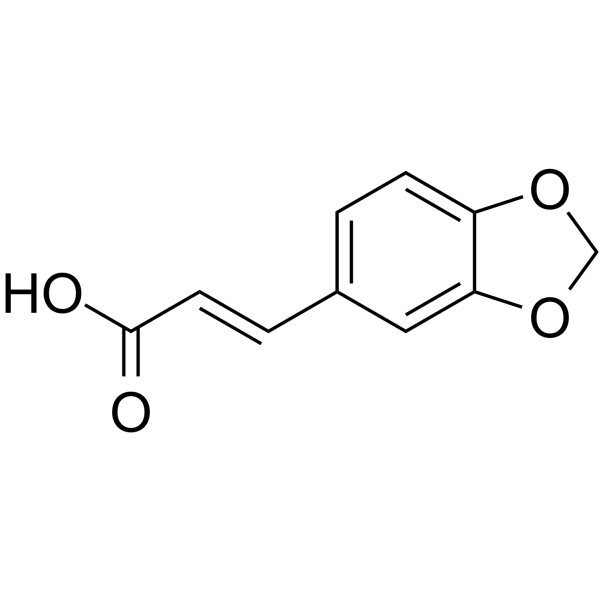
3,4-(Methylenedioxy)cinnamic acid
CAS No. 2373-80-0
3,4-(Methylenedioxy)cinnamic acid( 3-(Benzo[d][1,3]dioxol-5-yl)acrylic acid )
Catalog No. M28635 CAS No. 2373-80-0
3,4-(Methylenedioxy)cinnamic acid is a plant-derived compound first extracted from roots of Asparagus officinalis and further characterized as an allelochemical.
Purity : >98% (HPLC)
 COA
Datasheet
HNMR
HPLC
MSDS
Handing Instructions
COA
Datasheet
HNMR
HPLC
MSDS
Handing Instructions
| Size | Price / USD | Stock | Quantity |
| 1 mL x 10 mM in DMSO | 28 | In Stock |


|
| 5MG | 49 | In Stock |
|
| 100MG | Get Quote | In Stock |
|
| 200MG | Get Quote | In Stock |
|
| 500MG | Get Quote | In Stock |
|
| 1G | Get Quote | In Stock |
|
Biological Information
-
Product Name3,4-(Methylenedioxy)cinnamic acid
-
NoteResearch use only, not for human use.
-
Brief Description3,4-(Methylenedioxy)cinnamic acid is a plant-derived compound first extracted from roots of Asparagus officinalis and further characterized as an allelochemical.
-
Description3,4-(Methylenedioxy)cinnamic acid is a plant-derived compound first extracted from roots of Asparagus officinalis and further characterized as an allelochemical.
-
In Vitro——
-
In Vivo——
-
Synonyms3-(Benzo[d][1,3]dioxol-5-yl)acrylic acid
-
PathwayOthers
-
TargetOther Targets
-
RecptorKetohexokinase (KHK)
-
Research Area——
-
Indication——
Chemical Information
-
CAS Number2373-80-0
-
Formula Weight192.17
-
Molecular FormulaC10H8O4
-
Purity>98% (HPLC)
-
SolubilityIn Vitro:?DMSO : ≥ 100 mg/mL (520.37 mM)
-
SMILESOC(C=Cc(cc1)cc2c1OCO2)=O
-
Chemical Name——
Shipping & Storage Information
-
Storage(-20℃)
-
ShippingWith Ice Pack
-
Stability≥ 2 years
Reference
1.Huard K, et al. Discovery of Fragment-Derived Small Molecules for in Vivo Inhibition of Ketohexokinase (KHK). J Med Chem. 2017 Sep 28;60(18):7835-7849.
molnova catalog



related products
-
ergosteryl 3-beta-D-...
Ergosterol glucoside is a phenolic compound that can be isolated from Tuber spp. truffles.
-
AKT/PKB/Rac - Protei...
AKTide-2T is an excellent in vitro substrate for AKT and shows competitive inhibition of histone H2B phosphorylation with a Ki of 12 nM. AKTide-2T mimics the optimal phosphorylation sequence of Akt and is an inhibitory peptide with the wildtype AKTide lacking Thr in the S22 position.
-
MangostanaxanthoneIV
MangostanaxanthoneIV
