


 Cart
Cart
 sales@molnova.com


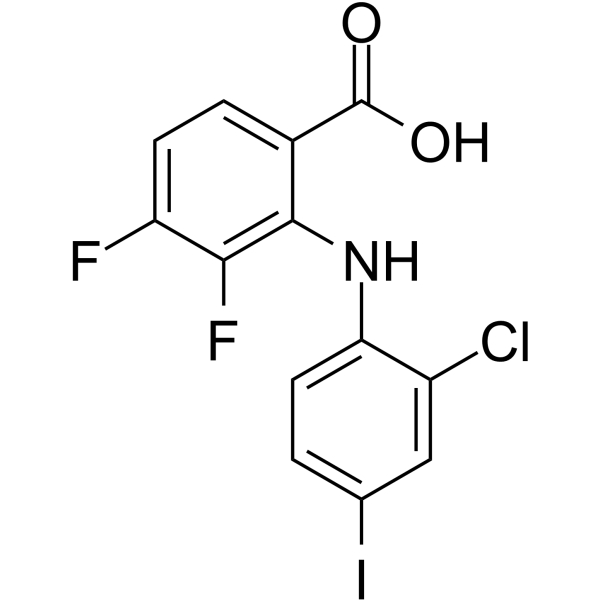
zapnometinib
CAS No. 303175-44-2
zapnometinib( 2-(2-chloro-4-iodoanilino)-3,4-difluorobenzoic acid | PD0184264 | ATR-002 )
Catalog No. M28604 CAS No. 303175-44-2
zapnometinib is a MEK inhibitor.
Purity : >98% (HPLC)
 COA
Datasheet
HNMR
HPLC
MSDS
Handing Instructions
COA
Datasheet
HNMR
HPLC
MSDS
Handing Instructions
| Size | Price / USD | Stock | Quantity |
| 5MG | 42 | In Stock |


|
| 10MG | 65 | In Stock |
|
| 25MG | 78 | In Stock |
|
| 50MG | 151 | In Stock |
|
| 100MG | 291 | In Stock |
|
| 200MG | 438 | In Stock |
|
| 500MG | Get Quote | In Stock |
|
| 1G | Get Quote | In Stock |
|
Biological Information
-
Product Namezapnometinib
-
NoteResearch use only, not for human use.
-
Brief Descriptionzapnometinib is a MEK inhibitor.
-
Descriptionzapnometinib is a MEK inhibitor.(In Vitro):Zapnometinib inhibits MEK, with IC50s of 30.96 nM, 357 nM, and 15 nM in cell free kinase assay, A549, MDCK cells and human PBMCs.Zapnometinib reduces the viral titers of the IV H1N1pdm09, H3N2.(In Vivo):Zapnometinib exhibits AUC values of 860.02 and 1953.68 μg h/mL in mice by i.v. or oral route, respectively.Zapnometinib reduces the lung virus titers and enhances survival of mice after lethal H1N1pdm09 infection.
-
In VitroWestern Blot Analysis Cell Line:human PBMCs Concentration:100 μM Incubation Time:4 h Result:Inhibited the Ionomycin (PMA/I)-increased pERK1/2.
-
In VivoAnimal Model:Female C57BL/6 mice (8 weeks; 21-24 g) were infected with H1N1pdm09 Dosage:8.4, 25, 75 mg/kg/day (2.8, 8.4, 25 mg/kg).Administration:P.o. three times a day Result:Significantly reduced the virus titer at the dose of either 75 mg/kg/day or 25 mg/kg/day.
-
Synonyms2-(2-chloro-4-iodoanilino)-3,4-difluorobenzoic acid | PD0184264 | ATR-002
-
PathwayMicrobiology/Virology
-
TargetInfluenza Virus
-
RecptorHuman Endogenous Metabolite
-
Research Area——
-
Indication——
Chemical Information
-
CAS Number303175-44-2
-
Formula Weight409.55
-
Molecular FormulaC13H7ClF2INO2
-
Purity>98% (HPLC)
-
SolubilityIn Vitro:?DMSO : 62.5 mg/mL (152.61 mM)
-
SMILESOC(c(c(Nc(ccc(I)c1)c1Cl)c1F)ccc1F)=O
-
Chemical Name——
Shipping & Storage Information
-
Storage(-20℃)
-
ShippingWith Ice Pack
-
Stability≥ 2 years
Reference
1.Kaur R, et al. Gluconic acid: an antifungal agent produced by Pseudomonas species in biological control of take-all. Phytochemistry. 2006 Mar;67(6):595-604.
molnova catalog



related products
-
Influenza HA 126-138
Influenza HA (126-138) is a influenza virus hemagglutinin (HA) peptide comprising amino acids 126-138, induces thymic and peripheral T-cell apoptosis.
-
N-Glycolylneuraminic...
N-Glycolylneuraminic acid is a nonhuman sialic acid molecule synthesized in pigs. N-Glycolylneuraminic acid is a receptor of human and animal IAVs.
-
Sanggenol A
Sanggenol A inhibits influenza A viral and pneumococcal neuraminidase, hence functioning as a dual-acting anti-infective agent.
