


 Cart
Cart
 sales@molnova.com


VPC-70063
CAS No. 13571-44-3
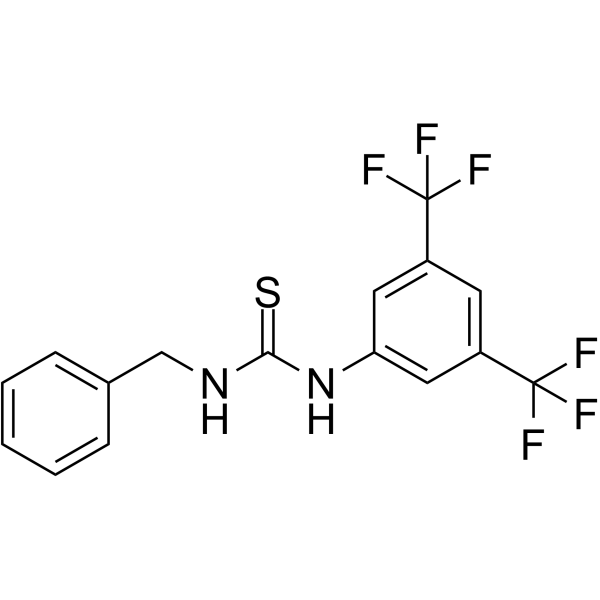
VPC-70063( Thiourea, N-[3,5-bis(trifluoromethyl)phenyl]-N'-(phenylmethyl)- )
Catalog No. M28492 CAS No. 13571-44-3
VPC-70063 is an inhibitor of c-Myc-MAX. VPC-70063 exhibits Myc-Max transcriptional activity inhibition of 106% with an IC50 of 8.9 μM and Myc-Max/UBE2C downstream pathway inhibition of 94%. VPC-70063 can be used for studies about anticancer.
Purity : >98% (HPLC)
 COA
Datasheet
HNMR
HPLC
MSDS
Handing Instructions
COA
Datasheet
HNMR
HPLC
MSDS
Handing Instructions
| Size | Price / USD | Stock | Quantity |
| 1 mL x 10 mM in DMSO | 132 | In Stock |


|
| 5MG | 103 | In Stock |
|
| 10MG | 155 | In Stock |
|
| 25MG | 282 | In Stock |
|
| 50MG | 398 | In Stock |
|
| 100MG | 579 | In Stock |
|
| 200MG | 817 | In Stock |
|
| 500MG | Get Quote | In Stock |
|
| 1G | Get Quote | In Stock |
|
Biological Information
-
Product NameVPC-70063
-
NoteResearch use only, not for human use.
-
Brief DescriptionVPC-70063 is an inhibitor of c-Myc-MAX. VPC-70063 exhibits Myc-Max transcriptional activity inhibition of 106% with an IC50 of 8.9 μM and Myc-Max/UBE2C downstream pathway inhibition of 94%. VPC-70063 can be used for studies about anticancer.
-
DescriptionVPC-70063 is an inhibitor of c-Myc-MAX. VPC-70063 exhibits Myc-Max transcriptional activity inhibition of 106% with an IC50 of 8.9 μM and Myc-Max/UBE2C downstream pathway inhibition of 94%. VPC-70063 can be used for studies about anticancer.(In Vitro):VPC-70063 (6.25, 12.5, and 25 μM) causes apoptosis of LNCaP cells as indicated by cleavage of PARP. VPC-70063 (0-500 μM) disrupts the interaction of Myc-Max with DNA in a dose-dependent manner.
-
In VitroVPC-70063 (25 μM; 96 h) shows Myc-Max transcriptional activity inhibition of 106% and Myc-Max/UBE2C downstream pathway inhibition of 94%.VPC-70063 (6.25-25 μM, 48 h) causes apoptosis of LNCaP cells as indicated by cleavage of PARP.VPC-70063 (0-500 μM; 0-600 s) disrupts the interaction of Myc-Max with DNA in a dose dependent manner.Western Blot Analysis Cell Line:LNCaP cells Concentration:6.25 μM, 12.5 μM and 25 μM Incubation Time:48 h Result:Induced PARP cleavage.
-
In Vivo——
-
SynonymsThiourea, N-[3,5-bis(trifluoromethyl)phenyl]-N'-(phenylmethyl)-
-
PathwayApoptosis
-
TargetApoptosis
-
RecptorP2X3
-
Research Area——
-
Indication——
Chemical Information
-
CAS Number13571-44-3
-
Formula Weight378.33
-
Molecular FormulaC16H12F6N2S
-
Purity>98% (HPLC)
-
Solubility——
-
SMILESFC(F)(F)C1=CC(=CC(=C1)C(F)(F)F)NC(=S)NCC=2C=CC=CC2
-
Chemical Name——
Shipping & Storage Information
-
Storage(-20℃)
-
ShippingWith Ice Pack
-
Stability≥ 2 years
Reference
molnova catalog



related products
-
Forodesine
Forodesine (BCX-1777) is an orally active and potent purine nucleoside phosphorylase (PNP) inhibitor, a new purine nucleoside analog.
-
Clovamide
Trans-Clovamide is a naturally occurring caffeoyl conjugate identified in the antioxidant polyphenolic fraction of cocoa (T. cacao L.) Trans-Clovamide is a potent antioxidantand that has shown neuroprotective effects (EC50s = 0.9-3.7 μM) in several in vitro models of neuronal death.
-
UCF 101
UCF 101 is a specific inhibitor of HtrA2 and reduces apoptosis in PC12 cells.
