


 Cart
Cart
 sales@molnova.com


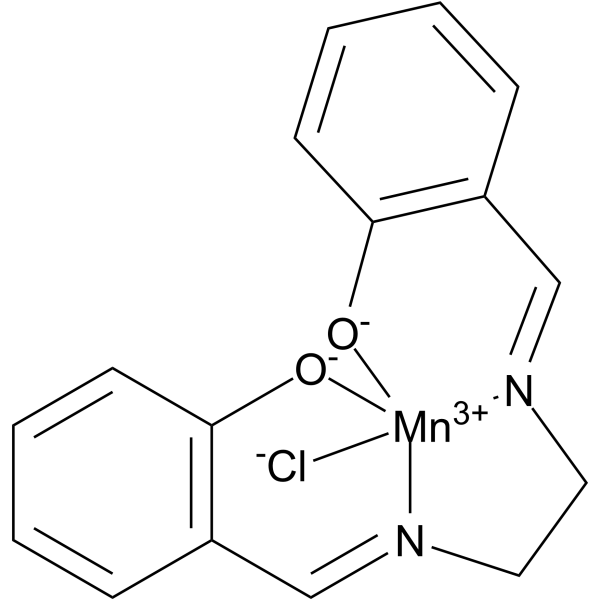
Manganese(salen) chloride
CAS No. 53177-12-1
Manganese(salen) chloride( EUK-8 )
Catalog No. M28316 CAS No. 53177-12-1
Manganese(salen) chloride (EUK-8), a superoxide dismutase and catalase mimetic, is an antioxidant with oxyradical scavenging properties. Manganese(salen) chloride ameliorates acute lung injury in endotoxemic swine.
Purity : >98% (HPLC)
 COA
Datasheet
HNMR
HPLC
MSDS
Handing Instructions
COA
Datasheet
HNMR
HPLC
MSDS
Handing Instructions
| Size | Price / USD | Stock | Quantity |
| 10MG | 29 | In Stock |


|
| 25MG | 46 | In Stock |
|
| 50MG | 65 | In Stock |
|
| 100MG | 91 | In Stock |
|
| 200MG | 138 | In Stock |
|
| 500MG | Get Quote | In Stock |
|
| 1G | Get Quote | In Stock |
|
Biological Information
-
Product NameManganese(salen) chloride
-
NoteResearch use only, not for human use.
-
Brief DescriptionManganese(salen) chloride (EUK-8), a superoxide dismutase and catalase mimetic, is an antioxidant with oxyradical scavenging properties. Manganese(salen) chloride ameliorates acute lung injury in endotoxemic swine.
-
DescriptionManganese(salen) chloride (EUK-8), a superoxide dismutase and catalase mimetic, is an antioxidant with oxyradical scavenging properties. Manganese(salen) chloride ameliorates acute lung injury in endotoxemic swine.(In Vitro):Manganese(salen) chloride (25 μM; 24-72 h) protects organotypic hippocampal slices from β-AP-induced neurotoxicity, and completely blocks β-AP-induced free radical accumulation and lipid peroxidation. (In Vivo):Manganese(salen) chloride (25 mg/kg; i.p. 3 times a week for 4 weeks) reduces cardiac oxidative stress and ameliorates pressure overload-induced heart failure in the harlequin mouse mutant . Animal Model: Wild-type (WT) and harlequin (Hq) B6CBA male and female mice Dosage: 25 mg/kg/day Administration: I.p. 3 times a week for 4 weeks Result: Prevented myocardial oxidant damage provoked by biomechanical stress. Improved survival following biomechanical stress. Prevented functional and geometrical deterioration in response to pressure overload. Attenuated necrotic and apoptotic cell death, and attenuated cardiac hypertrophy and fibrosis.
-
In VitroManganese(salen) chloride (25 μM; 24-72 h) protects organotypic hippocampal slices from β-AP-induced neurotoxicity, and completely blocks β-AP-induced free radical accumulation and lipid peroxidation.
-
In VivoManganese(salen) chloride (25 mg/kg; i.p. 3 times a week for 4 weeks) reduces cardiac oxidative stress and ameliorates pressure overload-induced heart failure in the harlequin mouse mutant. Animal Model:Wild-type (WT) and harlequin (Hq) B6CBA male and female mice Dosage:25 mg/kg/day Administration:I.p. 3 times a week for 4 weeksResult:Prevented myocardial oxidant damage provoked by biomechanical stress.Improved survival following biomechanical stress.Prevented functional and geometrical deterioration in response to pressure overload. Attenuated necrotic and apoptotic cell death, and attenuated cardiac hypertrophy and fibrosis.
-
SynonymsEUK-8
-
PathwayOthers
-
TargetOther Targets
-
Recptormonophenolase
-
Research Area——
-
Indication——
Chemical Information
-
CAS Number53177-12-1
-
Formula Weight356.69
-
Molecular FormulaC16H14ClMnN2O2
-
Purity>98% (HPLC)
-
SolubilityIn Vitro:?DMSO : 8.33 mg/mL (23.35 mM)
-
SMILES[Cl-].[Mn+5].[O-]c1ccccc1\C=[N-]\CC\[N-]=C/c1ccccc1[O-]
-
Chemical Name——
Shipping & Storage Information
-
Storage(-20℃)
-
ShippingWith Ice Pack
-
Stability≥ 2 years
Reference
1.Fu B, et al. Isolation and identification of flavonoids in licorice and a study of their inhibitory effects on tyrosinase. J Agric Food Chem. 2005 Sep 21;53(19):7408-14.
molnova catalog



related products
-
Strychnine N-oxide
Strychnine N-oxide;Genostrychnine;N-Oxystrychnine
-
β-Lipotropin (61-69)
β-Lipotropin (61-69)
-
Hexa-His
Hexa His is an amino acid sequence consisting of 6 His residues in a row, it is also known as hexa histidine-tag, 6xHis-tag, and by the trademarked name His-tag. Hexa His Responsible for the degradation of GM2 gangliosides, and a variety of other molecules containing terminal N-acetyl hexosamines, in the brain and other tissues.
