


 Cart
Cart
 sales@molnova.com


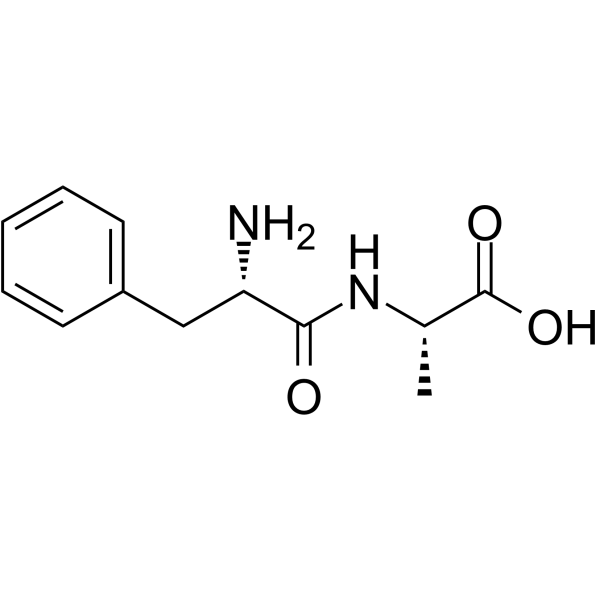
Phenylalanylalanine
CAS No. 3918-87-4
Phenylalanylalanine( H-Phe-Ala-OH )
Catalog No. M28304 CAS No. 3918-87-4
Phenylalanylalanine (H-Phe-Ala-OH) is a dipeptide composed of phenylalanine and alanine. Phenylalanylalanine is an incomplete breakdown product of protein digestion or protein catabolism.
Purity : >98% (HPLC)
 COA
Datasheet
HNMR
HPLC
MSDS
Handing Instructions
COA
Datasheet
HNMR
HPLC
MSDS
Handing Instructions
| Size | Price / USD | Stock | Quantity |
| 1 mL x 10 mM in DMSO | 28 | In Stock |


|
| 100MG | Get Quote | In Stock |
|
| 200MG | 27 | In Stock |
|
| 500MG | Get Quote | In Stock |
|
| 1G | Get Quote | In Stock |
|
Biological Information
-
Product NamePhenylalanylalanine
-
NoteResearch use only, not for human use.
-
Brief DescriptionPhenylalanylalanine (H-Phe-Ala-OH) is a dipeptide composed of phenylalanine and alanine. Phenylalanylalanine is an incomplete breakdown product of protein digestion or protein catabolism.
-
DescriptionPhenylalanylalanine (H-Phe-Ala-OH) is a dipeptide composed of phenylalanine and alanine. Phenylalanylalanine is an incomplete breakdown product of protein digestion or protein catabolism.
-
In Vitro——
-
In Vivo——
-
SynonymsH-Phe-Ala-OH
-
PathwayOthers
-
TargetOther Targets
-
RecptorTyrosinase|Calcium Channel|Antifection|Antibacterial
-
Research Area——
-
Indication——
Chemical Information
-
CAS Number3918-87-4
-
Formula Weight236.271
-
Molecular FormulaC12H16N2O3
-
Purity>98% (HPLC)
-
SolubilityIn Vitro:?H2O : 100 mg/mL (423.24 mM)
-
SMILESC[C@H](NC(=O)[C@@H](N)Cc1ccccc1)C(O)=O
-
Chemical Name——
Shipping & Storage Information
-
Storage(-20℃)
-
ShippingWith Ice Pack
-
Stability≥ 2 years
Reference
1.Ruddock PS, et al. Antimicrobial activity of flavonoids from Piper lanceaefolium and other Colombian medicinal plants against antibiotic susceptible and resistant strains of Neisseria gonorrhoeae. Sex Transm Dis. 2011 Feb;38(2):82-8.
molnova catalog



related products
-
L-DABA hydrobromide
L-DABA hydrobromide (L-2,4-Diaminobutyric acid hydrobromide) is a potent GABA transaminase inhibitor with antitumor and anticonvulsant activity for the study of neurological disorders.
-
SN-38-D3
SN-38-d3 is the deuterium labeled SN-38. SN-38 (NK012) is an active metabolite of the Topoisomerase I inhibitor Irinotecan. SN-38 (NK012) inhibits DNA and RNA synthesis with IC50s of 0.077 and 1.3 μM, respectively.
-
Basic Red 2
Basic Red 2 is an industrial dyes.
