


 Cart
Cart
 sales@molnova.com


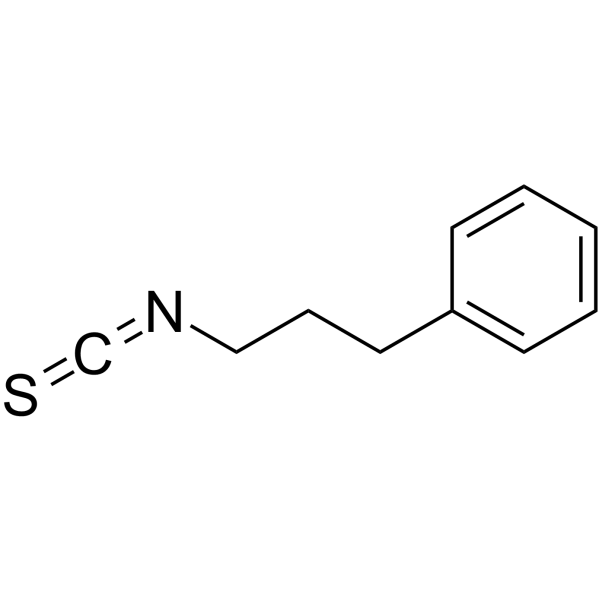
3-Phenylpropyl isothiocyanate
CAS No. 2627-27-2
3-Phenylpropyl isothiocyanate( —— )
Catalog No. M28287 CAS No. 2627-27-2
3-Phenylpropyl isothiocyanate has a stronger inhibitory effect on N-nitrosomethyl-benzylamine (NMBA) tumorigenesis. 3-Phenylpropyl isothiocyanate has chemopreventive effects.
Purity : >98% (HPLC)
 COA
Datasheet
HNMR
HPLC
MSDS
Handing Instructions
COA
Datasheet
HNMR
HPLC
MSDS
Handing Instructions
| Size | Price / USD | Stock | Quantity |
| 1 mL x 10 mM in DMSO | 195 | In Stock |


|
| 5MG | 249 | In Stock |
|
| 10MG | 369 | In Stock |
|
| 25MG | 562 | In Stock |
|
| 50MG | 770 | In Stock |
|
| 100MG | 1032 | In Stock |
|
| 200MG | 1376 | In Stock |
|
| 500MG | Get Quote | In Stock |
|
| 1G | Get Quote | In Stock |
|
Biological Information
-
Product Name3-Phenylpropyl isothiocyanate
-
NoteResearch use only, not for human use.
-
Brief Description3-Phenylpropyl isothiocyanate has a stronger inhibitory effect on N-nitrosomethyl-benzylamine (NMBA) tumorigenesis. 3-Phenylpropyl isothiocyanate has chemopreventive effects.
-
Description3-Phenylpropyl isothiocyanate has a stronger inhibitory effect on N-nitrosomethyl-benzylamine (NMBA) tumorigenesis. 3-Phenylpropyl isothiocyanate has chemopreventive effects.(In Vivo):3-Phenylpropyl isothiocyanate (5, 1, or 0.2 μmol; gavage; A/J mice; daily for 4 consecutive days prior to administration of 10 μmol of NNK by i.p. injection) effectively inhibited NNK-induced lung tumors. In vivo, 3-Phenylpropyl isothiocyanate decreases lung tumor formation induced by benzo[a]pyrene and NNK .
-
In Vitro——
-
In Vivo3-Phenylpropyl isothiocyanate (5, 1, or 0.2 μmol; gavage; A/J mice; daily for 4 consecutive days prior to administration of 10 μmol of NNK by i.p. injection) effectively inhibited NNK-induced lung tumors.
-
Synonyms——
-
PathwayOthers
-
TargetOther Targets
-
Recptortau|Tubulin
-
Research Area——
-
Indication——
Chemical Information
-
CAS Number2627-27-2
-
Formula Weight177.27
-
Molecular FormulaC10H11NS
-
Purity>98% (HPLC)
-
Solubility——
-
SMILESS=C=NCCCC1=CC=CC=C1
-
Chemical Name——
Shipping & Storage Information
-
Storage(-20℃)
-
ShippingWith Ice Pack
-
Stability≥ 2 years
Reference
1.Nozal V, et al. TDP-43 Modulation by Tau-Tubulin Kinase 1 Inhibitors: A New Avenue for Future Amyotrophic Lateral Sclerosis Therapy. J Med Chem. 2022;65(2):1585-1607.
molnova catalog



related products
-
Cyclocurcumin
Cyclocurcumin, a curcumin derivative, exhibits anticancer, anti-inflammatory, and immune-modulating abilities and is a potential compound for the treatment of rheumatoid arthritis as predicted by the MM-PBSA method.
-
Dynorphin A (1-12), ...
Dynorphin A (1-12), porcine
-
Dehydrodiisoeugenol
Dehydrodiisoeugenol inhibited the expression of the COX-2 in RAW264.7 murine macrophages stimulated with LPS.
