


 Cart
Cart
 sales@molnova.com


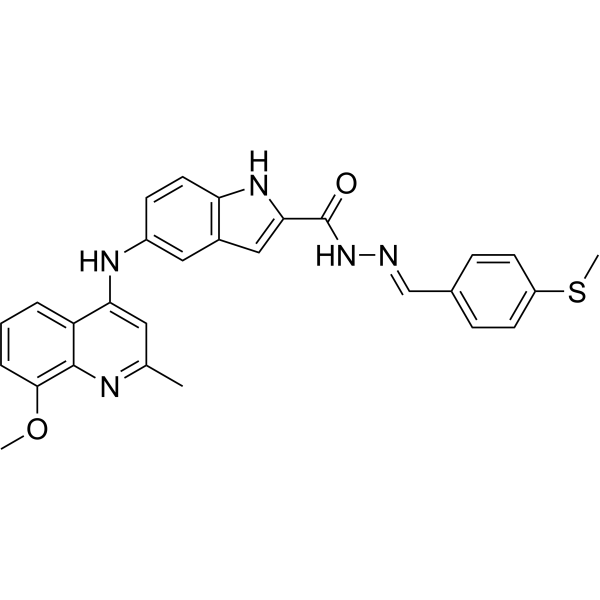
Nur77 modulator 1
CAS No. 2469975-55-9
Nur77 modulator 1( —— )
Catalog No. M28278 CAS No. 2469975-55-9
Nur77 modulator 1 is a good Nur77 binder (K D = 3.58 μM). Nur77 modulator 1 up-regulates Nur77 expression, mediates sub-cellular localization of Nur77, induces Nur77-dependent ER stress and autophagy, and results in cell apoptosis. Anti-hepatoma activity .
Purity : >98% (HPLC)
 COA
Datasheet
HNMR
HPLC
MSDS
Handing Instructions
COA
Datasheet
HNMR
HPLC
MSDS
Handing Instructions
| Size | Price / USD | Stock | Quantity |
| 1 mL x 10 mM in DMSO | 147 | In Stock |


|
| 5MG | 136 | In Stock |
|
| 10MG | 226 | In Stock |
|
| 25MG | 372 | In Stock |
|
| 50MG | 498 | In Stock |
|
| 100MG | 686 | In Stock |
|
| 200MG | 923 | In Stock |
|
| 500MG | Get Quote | In Stock |
|
| 1G | Get Quote | In Stock |
|
Biological Information
-
Product NameNur77 modulator 1
-
NoteResearch use only, not for human use.
-
Brief DescriptionNur77 modulator 1 is a good Nur77 binder (K D = 3.58 μM). Nur77 modulator 1 up-regulates Nur77 expression, mediates sub-cellular localization of Nur77, induces Nur77-dependent ER stress and autophagy, and results in cell apoptosis. Anti-hepatoma activity .
-
DescriptionNur77 modulator 1 is a good Nur77 binder (K D = 3.58 μM). Nur77 modulator 1 up-regulates Nur77 expression, mediates sub-cellular localization of Nur77, induces Nur77-dependent ER stress and autophagy, and results in cell apoptosis. Anti-hepatoma activity .(In Vitro):Nur77 modulator 1 (10g, 0-20 μM) displays potent and broad-spectrum antiproliferative activity against all tested three hepatoma cell lines (HepG2, QGY-7703, and SMMC-7721), and less cytotoxicity against LO2 cells (human normal liver cell line) . Nur77 modulator 1 (10g, ) could specifically up-regulate the expression of Nur77 in a dose-dependent manner . Nur77 modulator 1 (10g, 2.0 μM) induces Nur77-dependent apoptosis . Nur77 modulator 1 (10g, 2.0 μM) increased LC3-II and Beclin1 protein levels in a dose-dependent manner (10g treatment does not enhance p62 degradation, indicating that autophagy induced by 10g is incomplete) . Cell Viability Assay . Cell Line: Liver cancer cell lines (HepG2, QGY-7703, and SMMC-7721). Concentration: 0-20 μM. Incubation Time: 12-24 hours. Result: Exhibited IC 50 values of 0.6 μM, 0.89 μM, 1.40 μM and >20 μM in HepG2, QGY-7703, SMMC-7721 and LO2 cells, respectively. Reduced the viability in a time-dependent manner. Induced cell morphology alteration, such as cell shrinkage, vesicles accumulated, and reduced cell number.(In Vivo):Nur77 modulator 1 (10g, 10 and 20 mg/kg/day) exhibits significant anti-tumor activity in mouse hepatoma HepG2 xenograft with good tolerability . Animal Model: Nude mouse hepatoma HepG2 xenograft . Dosage: 10 and 20 mg/kg/day. Administration: IP, once every day for 15 days. Result: Lead to substantial suppression of tumor growth. The tumor growth inhibition (TGI) values at doses of 10mg/kg/day and 20 mg/kg/day were 36.74 % and 62.38 %, respectively. Exhibited almost no influence on the body weight of experimental mice.
-
In VitroNur77 modulator 1 (10g, 0-20 μM) displays potent and broad-spectrum antiproliferative activity against all tested three hepatoma cell lines (HepG2, QGY-7703, and SMMC-7721), and less cytotoxicity against LO2 cells (human normal liver cell line).Nur77 modulator 1 (10g, ) could specifically up-regulate the expression of Nur77 in a dose-dependent manner.Nur77 modulator 1 (10g, 2.0 μM) induces Nur77-dependent apoptosis.Nur77 modulator 1 (10g, 2.0 μM) increased LC3-II and Beclin1 protein levels in a dose-dependent manner (10g treatment does not enhance p62 degradation, indicating that autophagy induced by 10g is incomplete). Cell Viability Assay.Cell Line:Liver cancer cell lines (HepG2, QGY-7703, and SMMC-7721).Concentration:0-20 μM.Incubation Time:12-24 hours.Result:Exhibited IC50 values of 0.6 μM, 0.89 μM, 1.40 μM and >20 μM in HepG2, QGY-7703, SMMC-7721 and LO2 cells, respectively.Reduced the viability in a time-dependent manner.Induced cell morphology alteration, such as cell shrinkage, vesicles accumulated, and reduced cell number.
-
In VivoNur77 modulator 1 (10g, 10 and 20 mg/kg/day) exhibits significant anti-tumor activity in mouse hepatoma HepG2 xenograft with good tolerability. Animal Model:Nude mouse hepatoma HepG2 xenograft.Dosage:10 and 20 mg/kg/day.Administration:IP, once every day for 15 days.Result:Lead to substantial suppression of tumor growth.The tumor growth inhibition (TGI) values at doses of 10mg/kg/day and 20 mg/kg/day were 36.74 % and 62.38 %, respectively.Exhibited almost no influence on the body weight of experimental mice.
-
Synonyms——
-
PathwayOthers
-
TargetOther Targets
-
RecptorIGF-1R|Akt|mTOR
-
Research Area——
-
Indication——
Chemical Information
-
CAS Number2469975-55-9
-
Formula Weight495.6
-
Molecular FormulaC28H25N5O2S
-
Purity>98% (HPLC)
-
SolubilityIn Vitro:?DMSO : 125 mg/mL (252.22 mM)
-
SMILESCOC1=CC=CC2=C1N=C(C)C=C2NC3=CC=C(NC(C(N/N=C/C4=CC=C(SC)C=C4)=O)=C5)C5=C3
-
Chemical Name——
Shipping & Storage Information
-
Storage(-20℃)
-
ShippingWith Ice Pack
-
Stability≥ 2 years
Reference
1.Seol HS, et al. Loss of miR-100 and miR-125b results in cancer stem cell properties through IGF2 upregulation in hepatocellular carcinoma. Sci Rep. 2020 Dec 8;10(1):21412.
molnova catalog



related products
-
Gemtuzumab
Gemtuzumab(CMA-676) is a monoclonal antibody directed against the CD33 antigen and consists of a recombinant humanized IgG4 antibody.
-
p-Ethoxybenzoic acid
4-Ethoxybenzoic acid is a compound of luminescent bioapplication.
-
[Arg8]-Vasotocin TFA
[Arg8]-Vasotocin (TFA) is a nonmammalian vertebrate neurohypophyseal peptide.
