


 Cart
Cart
 sales@molnova.com


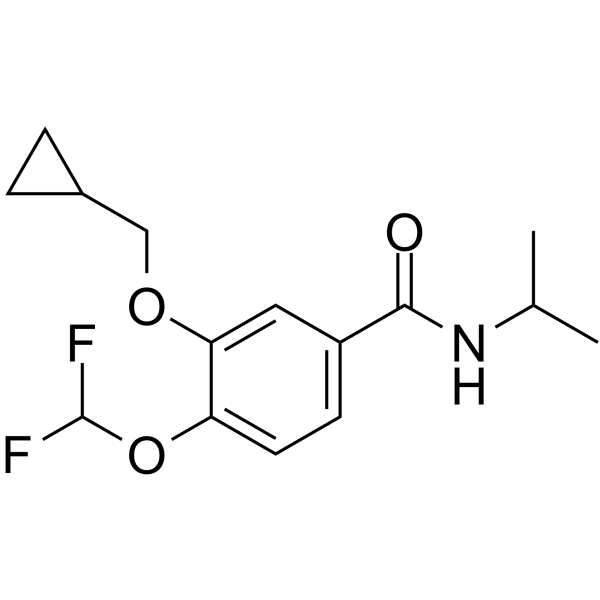
FCPR03
CAS No. 1917347-65-9
FCPR03( —— )
Catalog No. M28221 CAS No. 1917347-65-9
FCPR03 is a selective inhibitor of phosphodiesterase 4 (PDE4) with IC50s of 31 nM, 47 nM, and 60 nM for PDE4B1, PDE4D7, and PDE4 catalytic domain, respectively.
Purity : >98% (HPLC)
 COA
Datasheet
HNMR
HPLC
MSDS
Handing Instructions
COA
Datasheet
HNMR
HPLC
MSDS
Handing Instructions
| Size | Price / USD | Stock | Quantity |
| 1 mL x 10 mM in DMSO | 86 | In Stock |


|
| 5MG | 79 | In Stock |
|
| 10MG | 128 | In Stock |
|
| 25MG | 219 | In Stock |
|
| 50MG | 304 | In Stock |
|
| 100MG | 414 | In Stock |
|
| 200MG | 558 | In Stock |
|
| 500MG | Get Quote | In Stock |
|
| 1G | Get Quote | In Stock |
|
Biological Information
-
Product NameFCPR03
-
NoteResearch use only, not for human use.
-
Brief DescriptionFCPR03 is a selective inhibitor of phosphodiesterase 4 (PDE4) with IC50s of 31 nM, 47 nM, and 60 nM for PDE4B1, PDE4D7, and PDE4 catalytic domain, respectively.
-
DescriptionFCPR03 is a selective inhibitor of phosphodiesterase 4 (PDE4) with IC50s of 31 nM, 47 nM, and 60 nM for PDE4B1, PDE4D7, and PDE4 catalytic domain, respectively. FCPR03 has neuroprotective, anti-inflammatory, and antidepressant-like effects.(In Vitro):FCPR03 displays at least 2100-fold selectivity over other PDEs (PDE1-3 and PDE5-11). In HT-22 cells, FCPR03 (5, 10, and 20 μM) increases cell viability under the oxygen-glucose deprivation (OGD) induced condition in a dose-dependent manner. FCPR03 (20 μM) increases the levels of phosphorylated AKT, GSK-3β, and β-catenin. FCPR03 (20 μM) protects against OGD-induced cellular apoptosis in both HT-22 cells and cortical neurons. The levels of mitochondrial membrane potential (MMP) and ROS are restored by FCPR03. FCPR03 (10 μM) shows significant protective effects.(In Vivo):In adult male Sprague-Dawley rats following cerebral ischemia-reperfusion, FCPR03 increases the levels of phosphorylated AKT, GSK3β and β-catenin within the ischemic penumbra. In rats following MCAO, FCPR03 (1.25, 2.5, 5 mg/kg; i.p.) reduces the infarct volume and improves neurobehavioral outcomes.
-
In VitroFCPR03 (5-20 μM; 30 hours; HT-22 cells) treatment increases cell viability (oxygen-glucose deprivation (OGD)-induced) in a dose-dependent manner, and 10 μM FCPR03 shows significant protective effects.FCPR03 (20 μM; 30 hours; HT-22 cells) treatment protects against OGD-induced cellular apoptosis in both HT-22 cells and cortical neurons. The levels of mitochondrial membrane potential (MMP) and ROS are also restored by FCPR03.FCPR03 (20 μM; 30 hours; HT-22 cells) treatment increases the levels of phosphorylated AKT, glycogen synthase kinase-3β (GSK3β), and β-catenin.Cell Viability Assay Cell Line:HT-22 cells Concentration:5 μM, 10 μM, 20 μM Incubation Time:30 hours Result:Increased cell viability in a dose-dependent manner.Apoptosis Analysis Cell Line:HT-22 cells Concentration:20 μM Incubation Time:30 hours Result:Reversed the effects of OGD and decreased the ratio of apoptotic cells.Western Blot Analysis Cell Line:HT-22 cells Concentration:20 μM Incubation Time:30 hours Result:Increased the levels of phosphorylated AKT, glycogen synthase kinase-3β (GSK3β), and β-catenin.
-
In VivoFCPR03 (1.25-5 mg/kg; intraperitoneal injection; once; adult male Sprague-Dawley rats) treatment reduces the infarct volume and improves neurobehavioral outcomes in rats following MCAO. FCPR03 increases the levels of phosphorylated AKT, GSK3β and β-catenin within the ischemic penumbra of rats following cerebral ischemia-reperfusion. Animal Model:Adult male Sprague-Dawley rats (250-280 g) induced middle cerebral artery occlusion (MCAO) Dosage:1.25 mg/kg, 2.5 mg/kg, 5 mg/kg Administration:Intraperitoneal injection; onceResult:Reduced the infarct volume and improved neurobehavioral outcomes in rats following MCAO.
-
Synonyms——
-
PathwayAngiogenesis
-
TargetPDE
-
Recptor——
-
Research Area——
-
Indication——
Chemical Information
-
CAS Number1917347-65-9
-
Formula Weight299.31
-
Molecular FormulaC15H19F2NO3
-
Purity>98% (HPLC)
-
SolubilityIn Vitro:?DMSO : 100 mg/mL (334.10 mM)
-
SMILESO=C(NC(C)C)C1=CC=C(OC(F)F)C(OCC2CC2)=C1
-
Chemical Name——
Shipping & Storage Information
-
Storage(-20℃)
-
ShippingWith Ice Pack
-
Stability≥ 2 years
Reference
1.S Kuss, et al. Electrochemical recognition and quantification of cytochrome c expression in Bacillus subtilis and aerobe/anaerobe Escherichia coli using N, N, N', N'-tetramethyl- para-phenylene-diamine (TMPD). Chem Sci. 2017 Nov 1;8(11):7682-7688.
molnova catalog



related products
-
BW-A78U
BW-A 78U is a PDE4 inhibitor (IC50: 3 μM). It is not inhibition on the lipopolysaccharide (LPS)-induced TNF-α release.
-
PF‐04447943
A potent, selective, brain penetrant, orally active PDE9A inhibitor with IC50 of 8.3 nM.
-
D 159687
D159687 is a selective?PDE4D?inhibitorhad a procognitive profile as it improved memory in the novel object recognition test but had no antidepressant or anxiolytic benefit.
