


 Cart
Cart
 sales@molnova.com


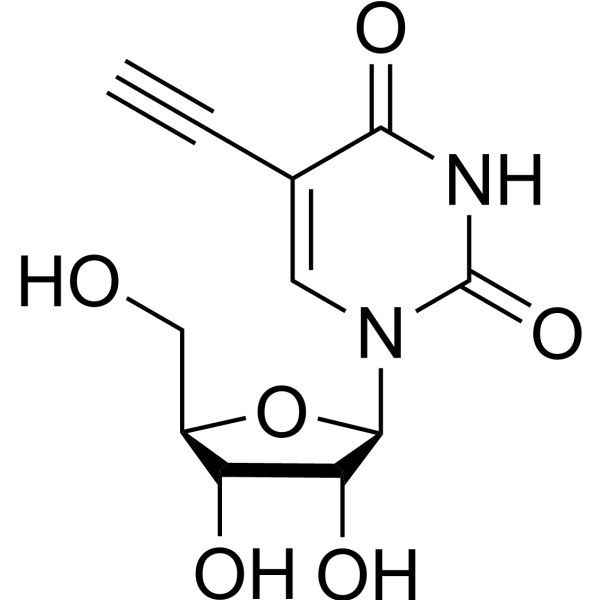
5-Ethynyluridine
CAS No. 69075-42-9
5-Ethynyluridine( 5-EU )
Catalog No. M28109 CAS No. 69075-42-9
5-Ethynyluridine can be used to label newly synthesized RNA. This approach, named capture of the newly transcribed RNA interactome using click chemistry (RICK), systematically captures proteins bound to a wide range of RNAs, including nascent RNAs and traditionally neglected nonpolyadenylated RNAs.
Purity : >98% (HPLC)
 COA
Datasheet
HNMR
HPLC
MSDS
Handing Instructions
COA
Datasheet
HNMR
HPLC
MSDS
Handing Instructions
| Size | Price / USD | Stock | Quantity |
| 1 mL x 10 mM in DMSO | 49 | In Stock |


|
| 5MG | 45 | In Stock |
|
| 10MG | 76 | In Stock |
|
| 25MG | 141 | In Stock |
|
| 50MG | 245 | In Stock |
|
| 100MG | Get Quote | In Stock |
|
| 200MG | Get Quote | In Stock |
|
| 500MG | Get Quote | In Stock |
|
| 1G | Get Quote | In Stock |
|
Biological Information
-
Product Name5-Ethynyluridine
-
NoteResearch use only, not for human use.
-
Brief Description5-Ethynyluridine can be used to label newly synthesized RNA. This approach, named capture of the newly transcribed RNA interactome using click chemistry (RICK), systematically captures proteins bound to a wide range of RNAs, including nascent RNAs and traditionally neglected nonpolyadenylated RNAs.
-
Description5-Ethynyluridine can be used to label newly synthesized RNA. This approach, named capture of the newly transcribed RNA interactome using click chemistry (RICK), systematically captures proteins bound to a wide range of RNAs, including nascent RNAs and traditionally neglected nonpolyadenylated RNAs.(In Vivo):EU labelling can be used to examine transcription in vivo in mouse models of nervous system disorders. Injection of EU directly into the cerebellum results in reproducible labelling of newly transcribed RNA in cerebellar neurons and glia, with cell type-specific differences in relative labelling intensities, such as Purkinje cells exhibiting the highest levels. EU-labelling accumulating into cytoplasmic inclusions, indicating that EU, like other modified uridines, may introduce non-physiological properties in labelled RNAs.
-
In Vitro——
-
In Vivo——
-
Synonyms5-EU
-
PathwayCell Cycle/DNA Damage
-
TargetNucleoside Antimetabolite/Analog
-
Recptor——
-
Research Area——
-
Indication——
Chemical Information
-
CAS Number69075-42-9
-
Formula Weight268.225
-
Molecular FormulaC11H12N2O6
-
Purity>98% (HPLC)
-
SolubilityIn Vitro:?DMSO : 100 mg/mL (372.83 mM)
-
SMILESOC[C@H]1O[C@H]([C@H](O)[C@@H]1O)n1cc(C#C)c(=O)[nH]c1=O
-
Chemical Name——
Shipping & Storage Information
-
Storage(-20℃)
-
ShippingWith Ice Pack
-
Stability≥ 2 years
Reference
1.Corazza M, et al. Irritant and sensitizing potential of eight surfactants commonly used in skin cleansers: an evaluation of 105 patients. Dermatitis. 2010 Sep-Oct;21(5):262-8.
molnova catalog



related products
-
7-Methylxanthine
Used as pharmaceutical intermediates.
-
Adenosine
Adenosine is a nucleoside composed of a molecule of adenine attached to a ribose sugar molecule (ribofuranose) moiety via a β-N9-glycosidic bond.
-
N6-Methyladenine
N6-Methyladenine is a modified purine commonly found in genomes of prokaryotes, protists, and plants. N6-methyladenine affects diverse DNA functions, including replication, repair, and expression.
