


 Cart
Cart
 sales@molnova.com


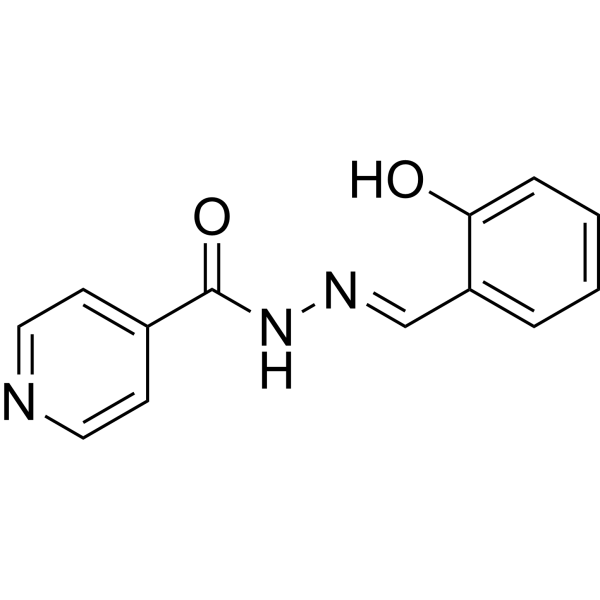
Salinazid
CAS No. 495-84-1
Salinazid( Salizid | Nilazid | Nupasal | Salizide | Salicylaldehyde isonicotinoyl hydrazone | SIH1 | )
Catalog No. M28013 CAS No. 495-84-1
Salinazid is a potent Cu(II) ionophore which preferentially kills HepG2 cells over HUVEC cells, and is superior to clioquinol.
Purity : >98% (HPLC)
 COA
Datasheet
HNMR
HPLC
MSDS
Handing Instructions
COA
Datasheet
HNMR
HPLC
MSDS
Handing Instructions
| Size | Price / USD | Stock | Quantity |
| 1 mL x 10 mM in DMSO | 37 | In Stock |


|
| 10MG | 28 | In Stock |
|
| 100MG | Get Quote | In Stock |
|
| 200MG | Get Quote | In Stock |
|
| 500MG | Get Quote | In Stock |
|
| 1G | Get Quote | In Stock |
|
Biological Information
-
Product NameSalinazid
-
NoteResearch use only, not for human use.
-
Brief DescriptionSalinazid is a potent Cu(II) ionophore which preferentially kills HepG2 cells over HUVEC cells, and is superior to clioquinol.
-
DescriptionSalinazid is a potent Cu(II) ionophore which preferentially kills HepG2 cells over HUVEC cells, and is superior to clioquinol.
-
In Vitro——
-
In Vivo——
-
SynonymsSalizid | Nilazid | Nupasal | Salizide | Salicylaldehyde isonicotinoyl hydrazone | SIH1 |
-
PathwayOthers
-
TargetOther Targets
-
RecptorAntifungal|tuberculosis
-
Research Area——
-
Indication——
Chemical Information
-
CAS Number495-84-1
-
Formula Weight241.25
-
Molecular FormulaC13H11N3O2
-
Purity>98% (HPLC)
-
SolubilityIn Vitro:?DMSO : ≥ 250 mg/mL (1036.27 m)
-
SMILESO=C(N/N=C/C1=CC=CC=C1O)C2=CC=NC=C2
-
Chemical Name——
Shipping & Storage Information
-
Storage(-20℃)
-
ShippingWith Ice Pack
-
Stability≥ 2 years
Reference
1.Imramovsky A, et al. Investigating spectrum of biological activity of 4- and 5-chloro-2-hydroxy-N-[2-(arylamino)-1-alkyl-2-oxoethyl]benzamides. Molecules. 2011 Mar 14;16(3):2414-30.
molnova catalog



related products
-
HIV-1 tat Protein (4...
HIV-1 tat Protein (49-57)
-
5-Epilithospermoside
(-)-5-Epilithospermoside is proposed as a potential marker of botanical origin for phacelia honey.
-
AS 602801
AS 602801(Bentamapimod) is a novel, orally active inhibitor of JNK.
