


 Cart
Cart
 sales@molnova.com


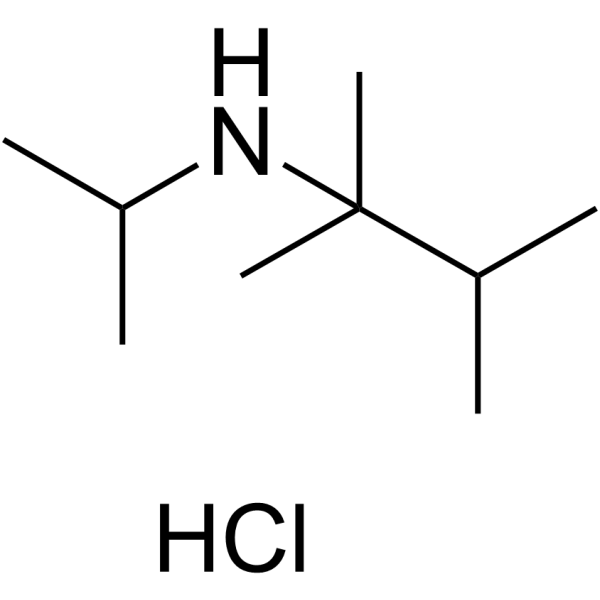
Iptakalim Hydrochloride
CAS No. 642407-63-4
Iptakalim Hydrochloride( —— )
Catalog No. M27888 CAS No. 642407-63-4
Iptakalim, a lipophilic para-amino compound, is a novel ATP-sensitive potassium channel (KATP) opener, as well as an α4β2-containing nicotinic acetylcholine receptor (nAChR) antagonist.
Purity : >98% (HPLC)
 COA
Datasheet
HNMR
HPLC
MSDS
Handing Instructions
COA
Datasheet
HNMR
HPLC
MSDS
Handing Instructions
| Size | Price / USD | Stock | Quantity |
| 1 mL x 10 mM in DMSO | 56 | In Stock |


|
| 5MG | 46 | In Stock |
|
| 10MG | 70 | In Stock |
|
| 25MG | 141 | In Stock |
|
| 50MG | 224 | In Stock |
|
| 100MG | 338 | In Stock |
|
| 200MG | Get Quote | In Stock |
|
| 500MG | Get Quote | In Stock |
|
| 1G | Get Quote | In Stock |
|
Biological Information
-
Product NameIptakalim Hydrochloride
-
NoteResearch use only, not for human use.
-
Brief DescriptionIptakalim, a lipophilic para-amino compound, is a novel ATP-sensitive potassium channel (KATP) opener, as well as an α4β2-containing nicotinic acetylcholine receptor (nAChR) antagonist.
-
DescriptionIptakalim, a lipophilic para-amino compound, is a novel ATP-sensitive potassium channel (KATP) opener, as well as an α4β2-containing nicotinic acetylcholine receptor (nAChR) antagonist. Iptakalim is also a K(ir) 6.1/SUR2B activator that can attenuate hypoxia-induced pulmonary arterial hypertension in rats by endothelial function protection.
-
In VitroIptakalim (Ipt) hydrochloride has been shown to reverse pulmonary resistance vascular remodeling, inhibit proliferation of pulmonary arterial smooth muscle cells (PASMCs) and airway smooth muscle cells (ASMCs), as well as protect PAECs from pathological stimulation.Iptakalim has an inhibitory effect on [Ca2+]cyt increase and the proliferation of pulmonary arterial SMCs induced by endothelin-1 through activation of KATP channels. Iptakalim (10 μM, 10 min) pretreatment of pulmonary arterial SMCs significantly prevents ransient ncrease of [Ca2+]cyt elicited by endothelin-1.Iptakalim at he concentrations of 0.1, 1, and 10 AM lowered[3H]thymidine incorporation by 19.75±4.60% (n=10), 41.20±9.49% (n=10), and 54.74±10.11% (n=10), respectively, compared with that of cells treated only with endothelin-1.
-
In VivoIptakalim (10-60 mg/kg) attenuates nicotine-evoked conditioned responding. Iptakalim also attenuates chamber activity in these nicotine test sessions..Iptakalim (60 mg/kg) pretreatment significantly reduced activity (LSD comparisons).. Animal Model:Thirty male Sprague-Dawley rats weighing 275-299 grams.Dosage:0, 10, 30, or 60 mg/kg.Administration:IP, 10 min before the start of a 4-min test session.Result:Decreased chamber activity.Dipper entries following pretreatment with 30 and 60 mg/kg Iptakalim were significantly lower than with 0 (saline) or 10 mg/kg iptakalim pretreatment (Tukey HSD tests).
-
Synonyms——
-
PathwayCell Cycle/DNA Damage
-
TargetPotassium Channel
-
RecptorAldose reductase
-
Research Area——
-
Indication——
Chemical Information
-
CAS Number642407-63-4
-
Formula Weight179.73
-
Molecular FormulaC9H22ClN
-
Purity>98% (HPLC)
-
SolubilityIn Vitro:?H2O : 25 mg/mL (139.10 mM)
-
SMILESCl.CC(C)NC(C)(C)C(C)C
-
Chemical Name——
Shipping & Storage Information
-
Storage(-20℃)
-
ShippingWith Ice Pack
-
Stability≥ 2 years
Reference
1.Simard-Duquesne N, et al. The effects of a new aldose reductase inhibitor (tolrestat) in galactosemic and diabetic rats. Metabolism. 1985 Oct;34(10):885-92.
molnova catalog



related products
-
Iberiotoxin
Selective blocker of the big conductance Ca2+-activated K+ channel.
-
Quinidine hydrochlor...
An optical isomer of quinine, extracted from the bark of the Cinchona tree and similar plant species.
-
BMS-191095
BMS-191095 is mitochondrial ATP-sensitive potassium (mitoKATP) channel activator.
