


 Cart
Cart
 sales@molnova.com


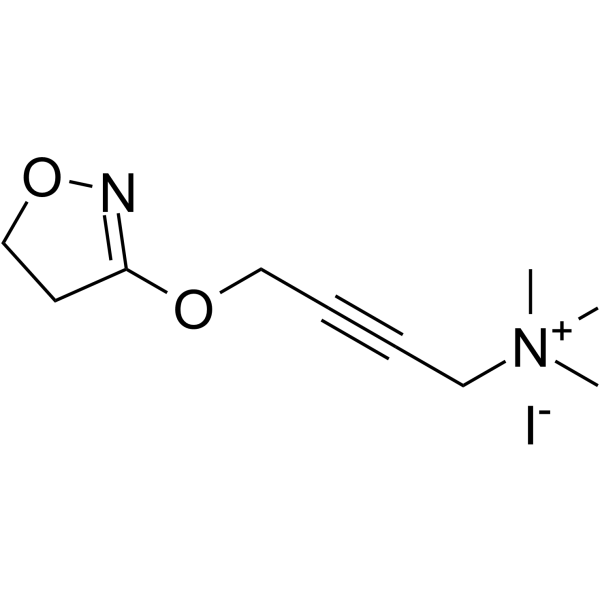
Iperoxo
CAS No. 247079-84-1
Iperoxo( Iperoxo iodide )
Catalog No. M27817 CAS No. 247079-84-1
Iperoxo, an OxotremorineM analog, is a muscarinic acetylcholine receptors superagonist.
Purity : >98% (HPLC)
 COA
Datasheet
HNMR
HPLC
MSDS
Handing Instructions
COA
Datasheet
HNMR
HPLC
MSDS
Handing Instructions
| Size | Price / USD | Stock | Quantity |
| 1 mL x 10 mM in DMSO | 113 | In Stock |


|
| 5MG | 103 | In Stock |
|
| 10MG | 168 | In Stock |
|
| 25MG | 339 | In Stock |
|
| 50MG | 500 | In Stock |
|
| 100MG | 733 | In Stock |
|
| 200MG | 1004 | In Stock |
|
| 500MG | Get Quote | In Stock |
|
| 1G | Get Quote | In Stock |
|
Biological Information
-
Product NameIperoxo
-
NoteResearch use only, not for human use.
-
Brief DescriptionIperoxo, an OxotremorineM analog, is a muscarinic acetylcholine receptors superagonist.
-
DescriptionIperoxo, an OxotremorineM analog, is a muscarinic acetylcholine receptors superagonist.
-
In Vitro——
-
In Vivo——
-
SynonymsIperoxo iodide
-
PathwayOthers
-
TargetOther Targets
-
RecptorAndrogen Receptor
-
Research Area——
-
Indication——
Chemical Information
-
CAS Number247079-84-1
-
Formula Weight182.223
-
Molecular FormulaC9H14N2O2
-
Purity>98% (HPLC)
-
SolubilityIn Vitro:?DMSO : 62.5 mg/mL (192.81 mM)
-
SMILESCN(C)CC#CCOC1=NOCC1
-
Chemical Name——
Shipping & Storage Information
-
Storage(-20℃)
-
ShippingWith Ice Pack
-
Stability≥ 2 years
Reference
1.Silveira AL, et al. Multiresidue Determination of the Anabolic-Agent Residues Steroids, Stilbenes, and Resorcylic Acid Lactones in Bovine Urine by GC-MS/MS with Microwave-Assisted Derivatization. J Agric Food Chem. 2018 Aug 15;66(32):8630-8638.
molnova catalog



related products
-
Undecanedioic acid
Undecanedioic acid has been found in parts of human aortas with advanced atherosclerotic lesions associated with intercellular matrix macromolecules and specifically with elastin.
-
(Nle27)-GRF (1-29) a...
(Nle27)-GRF (1-29) amide (human)
-
Gastric Inhibitory P...
Gastric Inhibitory Peptide, porcine is a glucose-dependent insulinotropic polypeptide, is a 42 amino acid intestinal hormone with effects on fat and glucose metabolism.
