


 Cart
Cart
 sales@molnova.com


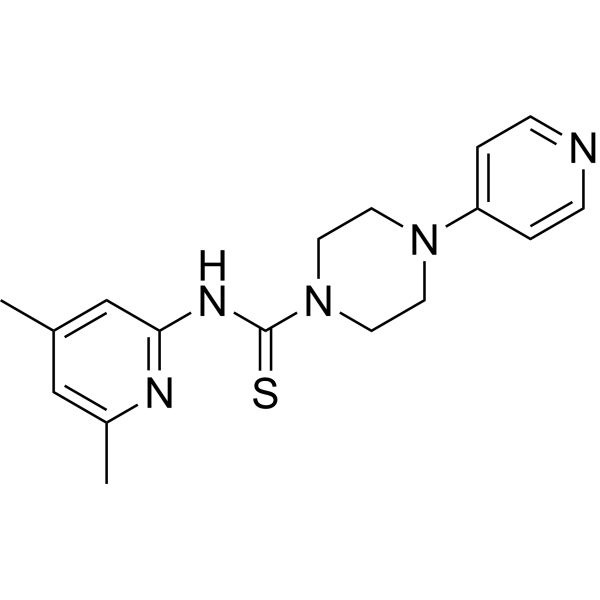
PHGDH-inactive
CAS No. 1914971-16-6
PHGDH-inactive( —— )
Catalog No. M27683 CAS No. 1914971-16-6
PHGDH inactive is inactive against PHGDH and serves as a negative control for NCT-502 and NCT-503 .
Purity : >98% (HPLC)
 COA
Datasheet
HNMR
HPLC
MSDS
Handing Instructions
COA
Datasheet
HNMR
HPLC
MSDS
Handing Instructions
| Size | Price / USD | Stock | Quantity |
| 1 mL x 10 mM in DMSO | 37 | In Stock |


|
| 5MG | 30 | In Stock |
|
| 10MG | 52 | In Stock |
|
| 25MG | 113 | In Stock |
|
| 50MG | 178 | In Stock |
|
| 100MG | 256 | In Stock |
|
| 200MG | 359 | In Stock |
|
| 500MG | Get Quote | In Stock |
|
| 1G | Get Quote | In Stock |
|
Biological Information
-
Product NamePHGDH-inactive
-
NoteResearch use only, not for human use.
-
Brief DescriptionPHGDH inactive is inactive against PHGDH and serves as a negative control for NCT-502 and NCT-503 .
-
DescriptionPHGDH inactive is inactive against PHGDH and serves as a negative control for NCT-502 and NCT-503 .
-
In Vitro——
-
In Vivo——
-
Synonyms——
-
PathwayOthers
-
TargetOther Targets
-
RecptorhCE2
-
Research Area——
-
Indication——
Chemical Information
-
CAS Number1914971-16-6
-
Formula Weight327.45
-
Molecular FormulaC17H21N5S
-
Purity>98% (HPLC)
-
SolubilityIn Vitro:?DMSO : 83.33 mg/mL (254.48 mM)
-
SMILESCc1cc(C)nc(NC(=S)N2CCN(CC2)c2ccncc2)c1
-
Chemical Name——
Shipping & Storage Information
-
Storage(-20℃)
-
ShippingWith Ice Pack
-
Stability≥ 2 years
Reference
1.Zhen-Peng Mai, et al. Biotransformation of alisol G by Penicillium janthinellum and the hCE2 inhibitory effects of its metabolites. Phytochemistry Letters, Volume 13, September 2015, Pages 228–233.
molnova catalog



related products
-
euonine
Evonimine (Euonine) is an alkaloid isolated from Tripterygium wilfordii Hook. Evonimine exhibits significant inhibition of humoral-mediated immunity using the haemolytic response as an indicator, and shows good anti-feeding activity against the lepidopteran Spodoptera littoralis.
-
2'-DEOXY-5-FLUOROCYT...
2'-DEOXY-5-FLUOROCYTIDINE is an ?inhibitor of DNA methyltransferase (DNMT) .
-
Mebrofenin
Mebrofenin is available as a ready to use the kit for radio-labeling with Tc-99m.Technetium Tc 99m Mebrofenin is a diagnostic radiopharmaceutical composed of diisopropyl-iminodiacetic acid (DISIDA) attached to a technetium-99m ion.
