


 Cart
Cart
 sales@molnova.com


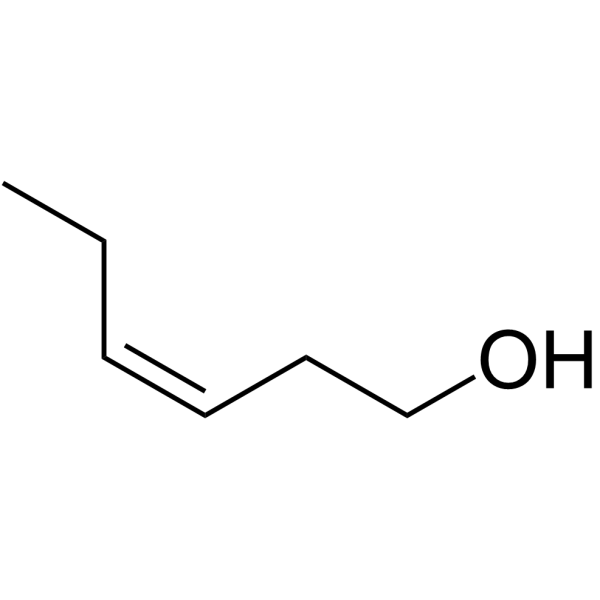
cis-3-Hexen-1-ol
CAS No. 928-96-1
cis-3-Hexen-1-ol( Leaf alcohol | (Z)-3-Hexen-1-ol )
Catalog No. M27539 CAS No. 928-96-1
Cis-3-Hexen-1-ol (Leaf alcohol) is an aroma compound which typically described as "green grassy" or the smell of "cut grass".
Purity : >98% (HPLC)
 COA
Datasheet
HNMR
HPLC
MSDS
Handing Instructions
COA
Datasheet
HNMR
HPLC
MSDS
Handing Instructions
| Size | Price / USD | Stock | Quantity |
| 100MG | Get Quote | In Stock |


|
| 200MG | Get Quote | In Stock |
|
| 500MG | Get Quote | In Stock |
|
| 1G | Get Quote | In Stock |
|
Biological Information
-
Product Namecis-3-Hexen-1-ol
-
NoteResearch use only, not for human use.
-
Brief DescriptionCis-3-Hexen-1-ol (Leaf alcohol) is an aroma compound which typically described as "green grassy" or the smell of "cut grass".
-
DescriptionCis-3-Hexen-1-ol (Leaf alcohol) is an aroma compound which typically described as "green grassy" or the smell of "cut grass". Cis-3-Hexen-1-ol has been found in many fresh fruits and vegetables and widely used as an added flavor in processed food and perfume. Cis-3-Hexen-1-ol is also an attractant to various insects.
-
In Vitro——
-
In Vivo——
-
SynonymsLeaf alcohol | (Z)-3-Hexen-1-ol
-
PathwayOthers
-
TargetOther Targets
-
Recptor——
-
Research Area——
-
Indication——
Chemical Information
-
CAS Number928-96-1
-
Formula Weight100.161
-
Molecular FormulaC6H12O
-
Purity>98% (HPLC)
-
SolubilityIn Vitro:?DMSO : 100 mg/mL (998.40 mM)
-
SMILESCC\C=C/CCO
-
Chemical Name——
Shipping & Storage Information
-
Storage(-20℃)
-
ShippingWith Ice Pack
-
Stability≥ 2 years
Reference
1.Shao L, et al. Synthesis and pharmacological characterization of bicyclic triple reuptake inhibitor 3-aryl octahydrocyclopenta[c]pyrrole analogues. J Med Chem. 2011 Aug 11;54(15):5283-95.
molnova catalog



related products
-
Rnase (90-105)
Rnase (90-105)
-
beta-Asarone
Beta-Asarone may be a potential preventive drug for Alzheimer's disease.
-
Tetramethylthiuram m...
Tetramethylthiuram monosulfide is widely used as a catalyst in rubber-processing techniques, it possesses a medium-degree toxicity and causes point mutations in strains TA 100 and TA 1535 (Salmonella typhimurium LT 2).
