


 Cart
Cart
 sales@molnova.com


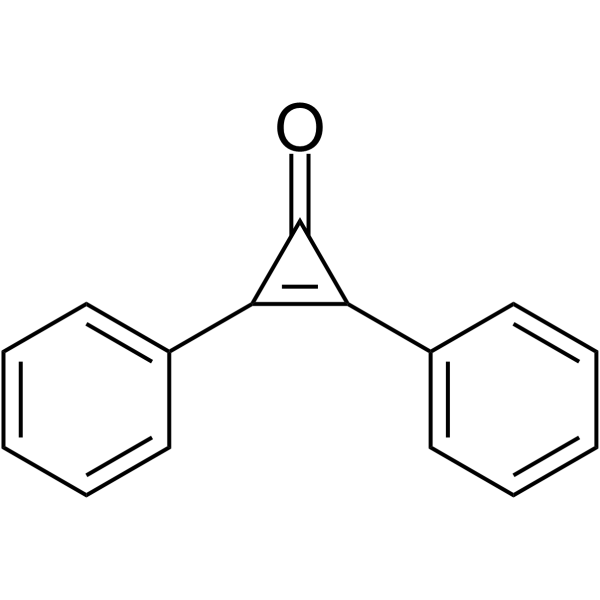
Diphenylcyclopropenone
CAS No. 886-38-4
Diphenylcyclopropenone( Diphencyprone | DPCP | Diphenylcyclopropenone )
Catalog No. M27405 CAS No. 886-38-4
Diphencyprone is a topical drug used to treat alopecia areata, alopecia totalis, and refractory warts.
Purity : >98% (HPLC)
 COA
Datasheet
HNMR
HPLC
MSDS
Handing Instructions
COA
Datasheet
HNMR
HPLC
MSDS
Handing Instructions
| Size | Price / USD | Stock | Quantity |
| 1 mL x 10 mM in DMSO | 28 | In Stock |


|
| 100MG | Get Quote | In Stock |
|
| 200MG | Get Quote | In Stock |
|
| 500MG | 35 | In Stock |
|
| 1G | Get Quote | In Stock |
|
Biological Information
-
Product NameDiphenylcyclopropenone
-
NoteResearch use only, not for human use.
-
Brief DescriptionDiphencyprone is a topical drug used to treat alopecia areata, alopecia totalis, and refractory warts.
-
DescriptionDiphencyprone is a topical drug used to treat alopecia areata, alopecia totalis, and refractory warts. Diphencyprone acts as a local stimulator that triggers an immune response against the action of autoreactive cells.
-
In Vitro——
-
In Vivo——
-
SynonymsDiphencyprone | DPCP | Diphenylcyclopropenone
-
PathwayOthers
-
TargetOther Targets
-
Recptor——
-
Research Area——
-
Indication——
Chemical Information
-
CAS Number886-38-4
-
Formula Weight206.244
-
Molecular FormulaC15H10O
-
Purity>98% (HPLC)
-
SolubilityIn Vitro:?DMSO : 100 mg/mL (484.87 mM)
-
SMILESO=c1c(c1-c1ccccc1)-c1ccccc1
-
Chemical Name——
Shipping & Storage Information
-
Storage(-20℃)
-
ShippingWith Ice Pack
-
Stability≥ 2 years
Reference
1.T Potrawfke , et al. Chlorocatechols Substituted at Positions 4 and 5 Are Substrates of the Broad-Spectrum Chlorocatechol 1,2-dioxygenase of Pseudomonas Chlororaphis RW71. J Bacteriol. 2001 Feb;183(3):997-1011.
molnova catalog



related products
-
5,8-Dihydroxy-6,-met...
5,7,8-Trihydroxy-6-methoxy flavone-7-O-glucuronideb is a natural product that can be isolated from Scutellaria baicalensis Georgi.
-
Methyl 4-Hydroxyphen...
Methyl 4-Hydroxyphenylacetate has potent inhibitory activity against tobacco mosaic virus (TMV).
-
5,6-DIAMINOPYRIDINE-...
5,6-DIAMINOPYRIDINE-3-CARBOXYLIC ACID METHYL ESTER is a useful organic compound for research related to life sciences. The catalog number is T9829 and the CAS number is 104685-76-9.
